
Many UK businesses find themselves in a frustrating cycle – delivering products or services, issuing invoices, and then waiting weeks or even months to get paid. This payment gap creates significant challenges, particularly for small and medium-sized enterprises with limited cash reserves.
Accounts receivable financing offers a powerful solution to this common problem. By leveraging your outstanding invoices, you can access immediate working capital without taking on traditional debt. This approach has become increasingly popular among UK businesses looking to maintain stable cash flow while pursuing growth opportunities.
This comprehensive guide will walk you through everything you need to know about accounts receivable financing – from understanding the basic concepts to implementing effective strategies that can transform your business’s financial health.
Understanding Accounts Receivable Financing
Accounts receivable financing represents a fundamental shift in how businesses can approach cash flow management. Rather than viewing unpaid invoices as a financial burden, this approach transforms them into valuable assets that can be leveraged to access immediate working capital.
The concept is straightforward but powerful. When you extend credit to customers by allowing them to pay invoices in 30, 60, or even 90 days, you’re essentially providing them with short-term financing. Accounts receivable financing reverses this dynamic, putting the cash back in your hands when you need it most.
This financing method has deep historical roots, with variations of factoring dating back centuries. In today’s UK business environment, it has evolved into a sophisticated financial tool offering flexibility and accessibility that traditional bank financing often cannot match.
For growing businesses, those experiencing seasonal fluctuations, or companies dealing with clients who pay on extended terms, accounts receivable financing provides a practical alternative to conventional borrowing. It aligns your funding with your sales cycle, creating a more natural and sustainable approach to cash flow management.
Have you ever found yourself in a position where business opportunities were available, but your cash was tied up in unpaid invoices? This is precisely the problem that accounts receivable financing solves.
Learn more about invoice financing in the UK
What is Accounts Receivable Financing?
Accounts receivable financing, also known as invoice financing or factoring, is a financial arrangement where businesses convert their outstanding invoices into immediate cash. Rather than waiting for customers to pay, you receive a significant percentage of the invoice value upfront from a specialised financing company.
This form of financing isn’t a loan in the traditional sense. Instead, it’s either a purchase of your receivables or an advance against them, depending on the specific arrangement. The financing company advances you a percentage of the invoice value—typically between 70% and 90%—and then collects payment directly from your customers when the invoices come due.
Once your customer pays the invoice, the financing company remits the remaining balance to you, minus their fee for the service. This fee is usually calculated as a percentage of the invoice value and varies based on factors such as your sales volume, your customers’ creditworthiness, and the payment terms of your invoices.
What makes accounts receivable financing particularly valuable is its focus on your customers’ ability to pay rather than solely on your own credit history. This makes it accessible to businesses that might struggle to qualify for traditional bank financing, including startups and companies with limited credit histories.
The basics to accounts receivable financing:
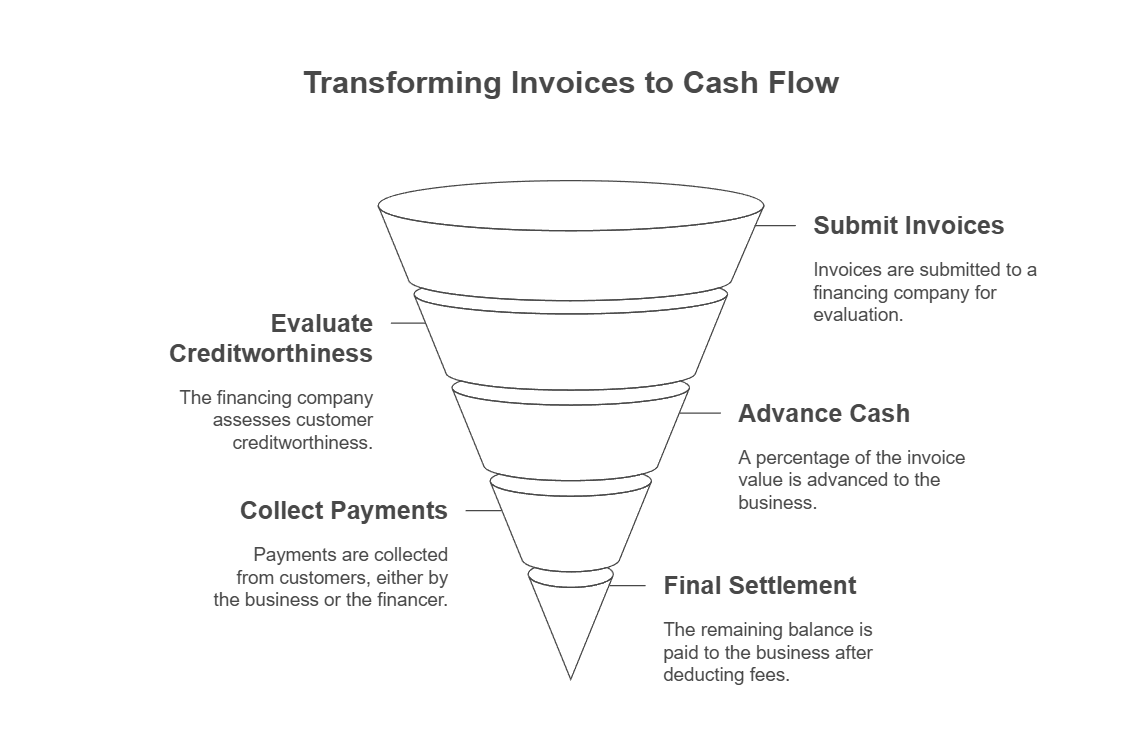
The process of accounts receivable financing follows a straightforward framework:
Invoice Generation: You provide goods or services to your customers and issue invoices with payment terms.
Financing Application: You submit these invoices to a financing company, which evaluates them based primarily on your customers’ creditworthiness.
Advance Payment: Upon approval, the financing company advances you a percentage of the invoice value, typically within 24-48 hours.
Collection Process: Depending on the type of arrangement, either you or the financing company collects payment from your customers when the invoices come due.
Final Settlement: After your customers pay, you receive the remaining balance of the invoice amount, minus the financing company’s fees.
The financing company’s fee structure typically includes a discount rate (the percentage of the invoice value charged as a fee) and sometimes a processing or service charge. These fees vary based on factors such as:
- The volume and value of invoices you’re financing
- The creditworthiness of your customers
- The payment terms of your invoices
- The specific services provided by the financing company
Unlike traditional loans, accounts receivable financing doesn’t create long-term debt on your balance sheet. Instead, it accelerates your cash flow by converting existing assets (your receivables) into immediate working capital.
Why should you consider accounts receivable financing?
Accounts receivable financing offers compelling advantages that make it worth considering for businesses facing cash flow challenges or seeking growth opportunities:
Immediate Cash Flow Relief: When you’re caught in the gap between completing work and receiving payment, accounts receivable financing provides a lifeline. It transforms your waiting period into productive time with the capital you need to operate and grow.
Growth Support Without Traditional Debt: Conventional growth financing often means taking on significant debt. Accounts receivable financing allows you to fund expansion using money that’s already earned but not yet collected.
Have you ever had to turn down a large order because you couldn’t afford the upfront costs? With accounts receivable financing, you can accept new business opportunities with confidence, knowing you’ll have the working capital to fulfill them.
Flexibility During Seasonal Fluctuations: Many businesses experience predictable busy and slow periods. Accounts receivable financing scales naturally with your sales volume, providing more funding during peak seasons when you need it most.
Focus on Core Business Activities: Chasing late payments can consume valuable time and resources. Some forms of accounts receivable financing include professional credit control services, allowing you to concentrate on running and growing your business.
Avoid Credit Risk: Non-recourse factoring arrangements can protect you from bad debt, with the financing company assuming the risk of non-payment by your customers.
For businesses with limited access to traditional bank financing—whether due to a short trading history, rapid growth that outpaces conventional lending criteria, or previous credit challenges—accounts receivable financing offers an accessible alternative based primarily on your customers’ creditworthiness rather than your own.
Get accounts receivable financing today, arranged through our panel of UK funders
How Accounts Receivable Financing Works
Accounts receivable financing operates through a structured process that converts your outstanding invoices into immediate working capital. Understanding this process in detail can help you determine if it’s the right solution for your business needs.
The journey begins when you deliver goods or services to your customers and issue invoices with payment terms. Instead of waiting for these invoices to be paid, you submit them to your chosen financing company. The financing company evaluates these invoices, focusing primarily on your customers’ creditworthiness and payment history rather than your own financial position.
Upon approval, the financing company advances you a percentage of the invoice value—typically between 70% and 90%—usually within 24-48 hours. This immediate injection of cash allows you to meet your financial obligations and pursue growth opportunities without waiting for customer payments.
When the invoice payment becomes due, the collection process begins. Depending on the specific arrangement you’ve chosen, either you or the financing company will be responsible for collecting payment from your customers. In factoring arrangements, the financing company handles collections directly, while with invoice discounting, you maintain control of the customer relationship and collection process.
Once your customer pays the invoice, the financing process concludes with a final settlement. The financing company remits the remaining balance of the invoice to you, after deducting their fees. These fees typically include a discount rate (a percentage of the invoice value) and may include additional charges for specific services.
The entire process creates a continuous cycle of financing that aligns with your sales activity. As you generate new invoices, you can continue to convert them into immediate cash, creating a sustainable approach to cash flow management that grows with your business.
Key Players in Accounts Receivable Financing
Three primary parties are involved in the accounts receivable financing process, each with distinct roles and responsibilities:
The Business (You): As the business seeking financing, you initiate the process by generating invoices through your normal sales activities. You’re responsible for delivering quality goods or services to your customers and maintaining accurate invoicing records. Depending on the type of financing arrangement, you may also retain responsibility for collecting payments from customers.
Your business benefits from improved cash flow, reduced payment waiting times, and potentially outsourced credit control services. However, you also bear the cost of the financing through fees paid to the financing company.
The Customers (Your Clients): Your customers are the entities that owe payment for the goods or services you’ve provided. They may or may not be aware of the financing arrangement, depending on whether you’ve chosen a confidential or disclosed facility.
In factoring arrangements, customers will be notified to make payments directly to the financing company. With confidential invoice discounting, customers continue to pay you as normal, unaware of the financing arrangement.
The creditworthiness of your customers plays a crucial role in the financing process, as the financing company evaluates their ability to pay when determining whether to approve your invoices for financing.
The Financing Company (the Funder): The financing company (or factor) provides the advance payment against your invoices and manages the overall financing process. They evaluate the creditworthiness of your customers, determine the advance rate and fee structure, and may handle collections depending on the arrangement.
Financing companies earn revenue through the fees they charge for their services. These typically include a discount rate (percentage of invoice value) and may include additional charges for specific services such as credit checks or collections.
Some financing companies specialise in particular industries or business sizes, offering expertise and services tailored to specific market segments. Others provide broader coverage across multiple sectors.
Discover how to select the right financing partner for your business
10 Benefits of Accounts Receivable Financing
Accounts receivable financing offers numerous advantages that can transform your business’s financial health and operational capabilities. Here are ten key benefits to consider:
1. Immediate Cash Flow Improvement
Perhaps the most significant benefit is the rapid conversion of outstanding invoices into working capital. Instead of waiting weeks or months for payment, you can access up to 90% of your invoice value within 24-48 hours. This immediate injection of cash helps you meet payroll obligations, cover operational expenses, and seize time-sensitive opportunities.
2. Growth Financing Without Traditional Debt
Accounts receivable financing allows you to fund expansion without taking on conventional loans. As your sales increase, so does your access to financing, creating a natural alignment between your growth and your funding. This can be particularly valuable for businesses experiencing rapid expansion that outpaces their ability to secure traditional financing.
3. Improved Financial Planning
With more predictable cash flow, you can develop more accurate financial forecasts and budgets. The reduced uncertainty about when you’ll receive payment makes it easier to plan for expenses, investments, and growth initiatives. How much more confidently could you plan your business strategy with reliable cash flow?
4. Enhanced Supplier Relationships
Access to timely working capital enables you to pay your suppliers promptly, potentially qualifying for early payment discounts and building stronger vendor relationships. This can lead to preferential treatment, better terms, and more reliable supply chains—all contributing to your competitive advantage.
5. Credit Risk Mitigation
Some forms of accounts receivable financing, particularly non-recourse factoring, provide protection against customer non-payment. The financing company assumes the risk of bad debt, shielding your business from potential losses due to customer insolvency or extended default.
6. Professional Credit Control Services
Many factoring arrangements include professional credit management and collection services. These specialised teams have expertise in securing timely payments and managing customer relationships effectively. This outsourced function can save you time and resources while potentially improving your collection rates.
7. Flexibility and Scalability
Unlike fixed loans, accounts receivable financing grows naturally with your business. As your sales increase, so does your access to funding. This scalability makes it particularly suitable for seasonal businesses or those experiencing rapid growth.
8. No Collateral Requirements Beyond Invoices
Traditional loans often require substantial collateral such as property or equipment. With accounts receivable financing, your invoices themselves serve as the primary security, making it accessible to businesses with limited hard assets.
9. Accessibility for New or Growing Businesses
Since financing decisions are based primarily on your customers’ creditworthiness rather than your own business history, accounts receivable financing can be accessible to startups and young companies that might struggle to qualify for traditional bank financing.
10. Competitive Advantage
The improved cash flow and financial stability provided by accounts receivable financing can give you a significant edge over competitors. You can accept larger orders, offer more competitive payment terms to customers, and invest in growth opportunities that might otherwise be beyond your reach.
Accounts receivable financing does not add debt to your balance sheet — it shortens the distance between the work you have already done and the cash it earned.
Types of Accounts Receivable Financing
Accounts receivable financing encompasses several distinct approaches, each with its own characteristics, advantages, and considerations. Understanding these different types can help you select the option that best aligns with your business needs and objectives.
Factoring / Financing:
Factoring is one of the most common and comprehensive forms of accounts receivable financing. In this arrangement, you sell your invoices to a factoring company (the factor), which then advances you a percentage of their value—typically 70% to 90%—within 24-48 hours.
The factor takes over the responsibility for collecting payment from your customers when invoices come due. Once customers pay, the factor remits the remaining balance to you, minus their fee. This fee usually ranges from 1% to 5% of the invoice value, depending on factors such as sales volume, customer creditworthiness, and payment terms.
Factoring is a disclosed arrangement, meaning your customers will be notified to make payments directly to the factoring company. The factor typically provides comprehensive services including:
- Credit checking of potential customers
- Professional collections and credit control
- Bad debt protection (in non-recourse arrangements)
- Online account management tools
- Regular reporting on payment status
This type of financing is particularly beneficial for businesses that:
- Want to outsource their credit control function
- Need protection against bad debt
- Lack the resources or expertise to manage collections effectively
- Value the additional services provided by factoring companies
Factoring creates a three-way relationship between your business, your customers, and the factor. While some businesses initially worry about how customers might perceive this arrangement, professional factors handle the relationship with sensitivity and professionalism, often enhancing rather than damaging customer relationships.
Want to understand the difference between invoice financing and factoring?
Invoice Discounting:
Invoice discounting offers many of the cash flow benefits of factoring while allowing you to maintain greater control over your customer relationships. With invoice discounting, you still receive an advance against your outstanding invoices—typically 80% to 90% of their value—but you retain responsibility for collecting payments from your customers.
This arrangement is usually confidential, meaning your customers are not aware that you’ve financed their invoices. You continue to manage your sales ledger and chase payments as normal, remitting customer payments to the financing company as they’re received.
Once customers pay their invoices, the financing company releases the remaining balance to you, minus their fee. These fees are often lower than factoring fees since the financing company provides fewer services and takes on less administrative responsibility.
Invoice discounting is particularly suitable for businesses that:
- Have effective credit control processes in place
- Want to maintain direct relationships with their customers
- Prefer a confidential financing arrangement
- Have the resources to manage collections effectively
This option provides the cash flow benefits of accounts receivable financing while allowing you to maintain greater control over your customer relationships and credit control processes. It’s often favoured by larger, more established businesses with robust internal systems.
Learn more about the difference between invoice financing and invoice discounting here.
Asset-Based Lending Option:
Asset-based lending (ABL) represents a more comprehensive financing approach that includes accounts receivable financing as one component of a broader funding facility. In an ABL arrangement, your business can secure funding against multiple asset classes, including:
- Accounts receivable (typically the primary component)
- Inventory
- Equipment and machinery
- Property and real estate
- Intellectual property (in some cases)
The financing company evaluates each asset class and establishes advance rates based on their liquidity and value. For accounts receivable, the advance rate might be 80-90%, while inventory might qualify for 50-60%, and equipment perhaps 50-80% of appraised value.
This creates a flexible funding facility that maximises the working capital available to your business by leveraging all your significant assets. ABL facilities are typically structured as revolving lines of credit, allowing you to draw funds as needed up to your established limit.
Asset-based lending is particularly valuable for:
- Larger businesses with substantial assets beyond accounts receivable
- Companies undergoing significant transitions (rapid growth, acquisition, turnaround)
- Businesses with seasonal inventory requirements
- Organisations needing higher funding levels than receivables alone can support
Explore Asset Finance Options Here.
Choosing an Accounts Receivable Financing Arrangement
Selecting the right accounts receivable financing structure is crucial for maximising benefits while minimising costs and potential drawbacks. Several key considerations should guide your decision-making process.
Start by assessing your specific business needs and objectives. Are you primarily seeking to improve cash flow, outsource collections, protect against bad debt, or fund growth? Different arrangements excel at addressing different challenges. For example, factoring provides comprehensive services including collections and credit control, while invoice discounting offers greater confidentiality and control.
Consider your customer relationships and how they might be affected by your financing choice. Some businesses worry that factoring might negatively impact customer perception, while others find that professional factors actually enhance the collection process and customer experience.
Evaluate your internal resources and capabilities. Do you have effective credit control systems and staff in place? If not, the collections services provided by factoring might be valuable. If you have strong internal processes, invoice discounting might be more appropriate.
Finally, compare the costs and terms offered by different providers. While fees are important, also consider advance rates, contract terms, minimum volume requirements, and the quality of service and support provided.
Recourse Financing
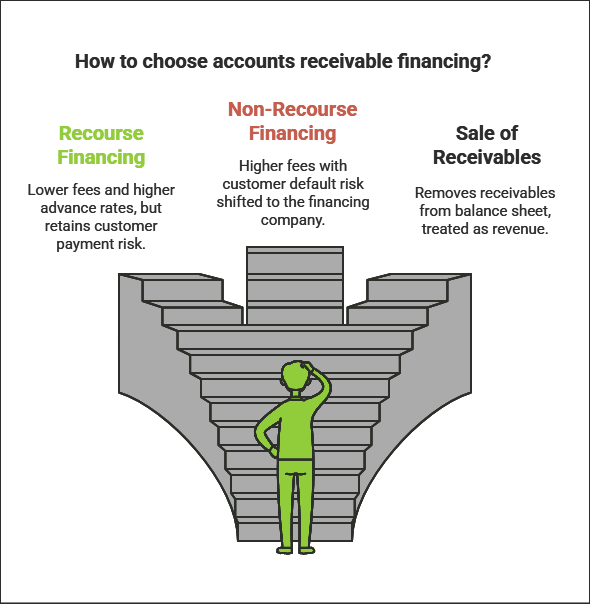
In recourse financing arrangements, your business retains the ultimate responsibility if your customers fail to pay their invoices. If a customer defaults, you must repay the financing company for the advance received against that invoice.
Recourse financing typically offers:
- Lower fees than non-recourse arrangements
- Higher advance rates (often 80-90% of invoice value)
- More flexible eligibility criteria
- Faster approval processes
This option is suitable for businesses with:
- Financially stable customers with good payment histories
- Strong cash flow that could absorb occasional repayments
- Confidence in their credit control processes
- A desire for lower financing costs
While recourse financing exposes your business to greater risk, the reduced fees can make it an attractive option if you have confidence in your customers’ ability to pay.
Non-Recourse Financing
Non-recourse financing shifts the risk of customer non-payment to the financing company. If your customer fails to pay due to insolvency or protracted default (typically defined as payment more than 90-120 days overdue), you are not required to repay the advance.
Non-recourse financing typically features:
- Higher fees to compensate for the increased risk to the financing company
- More rigorous customer credit checks
- Potentially lower advance rates
- Greater protection against bad debt
This option is particularly valuable for businesses:
- Operating in industries with higher default rates
- Dealing with customers of uncertain financial stability
- Seeking protection against unexpected customer insolvency
- Willing to pay higher fees for reduced risk exposure
Additional Tip: It’s important to note that non-recourse protection typically covers customer insolvency but may not cover disputes or other reasons for non-payment. Always review the specific terms of the non-recourse protection offered.
If you would rather insure the risk than transfer it inside the facility, our guide to protecting your business with trade credit insurance covers the alternative.
Sale of receivables or loan?
A fundamental distinction in accounts receivable financing is whether the arrangement constitutes a true sale of receivables or a loan secured against them. This distinction has important legal, accounting, and practical implications.
In a true sale arrangement (typical in factoring):
- The receivables are removed from your balance sheet
- The financing appears as revenue rather than debt
- The financing company has direct rights to collect from your customers
- The arrangement may offer greater protection in case of your business’s insolvency
In a loan arrangement (common in invoice discounting):
- The receivables remain on your balance sheet
- The financing appears as debt
- You retain primary responsibility for collections
- The financing company has a security interest in your receivables
The accounting treatment can significantly impact your financial statements and key ratios. Consult with your accountant to understand the implications for your specific situation.
Learn more about invoice discounting in the UK here.
Confidential arrangement or disclosed arrangement?
The choice between confidential and disclosed financing arrangements affects how your customers experience the relationship and can have significant implications for your business reputation.
In a confidential arrangement (typical in invoice discounting):
- Your customers are unaware of the financing
- You continue to manage customer relationships and collections
- Your business maintains complete control over customer communications
- There’s no risk of customers perceiving financial instability
In a disclosed arrangement (common in factoring):
- Your customers are notified to pay the financing company directly
- The financing company manages collections and customer communications
- Your business benefits from professional credit control services
- There’s potential for customers to question your financial stability
While many businesses initially prefer confidential arrangements to maintain customer perception, disclosed arrangements often prove less problematic than anticipated. Professional factors handle customer relationships with care, and many customers are familiar with factoring as a common business practice rather than a sign of financial distress.
Take out the guess work — get a quote and let Guavas Finance match you with the right funder
Understanding Your Eligibility Requirements for Accounts Receivable Financing
While accounts receivable financing is more accessible than many traditional funding options, providers still have specific eligibility criteria to manage their risk. Understanding these requirements can help you determine if your business is a good candidate and how to improve your chances of approval.
Business Type and Structure: Most financing companies focus on business-to-business (B2B) or business-to-government (B2G) invoices. Consumer invoices are typically not eligible due to higher collection risks. Your business structure (limited company, partnership, sole trader) may also affect eligibility, with limited companies often finding more options available.
Trading History: While some providers work with startups, most prefer businesses with at least 6-12 months of trading history. This allows them to evaluate your sales patterns, customer payment behaviour, and overall business stability.
Invoice Volume and Value: Many financing companies have minimum monthly turnover requirements, often starting around £10,000-£25,000. Some also have minimum invoice values or prefer businesses with a diverse customer base rather than reliance on a single large customer.
Customer Creditworthiness: Since the financing is secured by your customers’ ability to pay, their creditworthiness is crucial. Financing companies will assess your customers’ financial stability, payment history, and industry reputation. Invoices to financially strong customers with good payment records are more likely to be approved.
Invoice Characteristics: Eligible invoices typically must be:
- For completed work or delivered goods (not progress billings)
- Free from disputes or potential offsets
- Not already pledged as security for other financing
- Within standard payment terms (usually 30-90 days)
Your Financial Health: While less important than in traditional lending, your business’s financial stability still matters. Significant tax arrears, CCJs (County Court Judgments), or insolvency proceedings may affect eligibility or terms.
To improve your eligibility for accounts receivable financing:
- Maintain accurate and organised financial records
- Implement strong credit control practices
- Diversify your customer base when possible
- Address any outstanding tax issues or legal judgments
- Build relationships with financing providers before urgent needs arise
Remember that different providers have different criteria. If one company declines your application, another might approve it based on different risk assessments or industry specialisation.
Get a quote and assess your financing eligibility for accounts receivable financing with Guavas
Process to Getting Receivable Financing
Securing accounts receivable financing involves several key steps. Understanding this process can help you prepare effectively and move through it efficiently.
1. Research and Preparation
Begin by researching potential financing providers, comparing their offerings, fees, and specialisations. Some factors specialise in specific industries or business sizes, offering expertise and terms tailored to your sector.
Prepare your financial documentation, including:
- Recent financial statements or management accounts
- Aged debtor reports showing outstanding invoices
- Customer lists with contact information
- Sample invoices and contracts
- Business bank statements
Having these documents ready will streamline the application process and demonstrate your organisational capabilities to potential providers.
2. Initial Consultation
Most financing companies begin with an initial consultation to understand your business, needs, and circumstances. This may occur in person, by phone, or online. Be prepared to discuss:
- Your business model and industry
- Current cash flow challenges and objectives
- Sales processes and invoicing procedures
- Customer payment patterns
- Your preferred financing structure
This consultation helps the provider determine if their services align with your needs and provides an opportunity for you to assess their expertise and approach.
3. Formal Application and Due Diligence
After the initial consultation, you’ll submit a formal application with supporting documentation. The financing company will conduct due diligence, which typically includes:
- Reviewing your financial statements and invoicing history
- Assessing your customers’ creditworthiness
- Verifying the validity of your invoices
- Checking for any liens or encumbrances on your receivables
- Evaluating your business’s overall financial health
This process may take anywhere from a few days to a couple of weeks, depending on the complexity of your business and the financing company’s procedures.
4. Facility Setup and Documentation
Once approved, the financing company will prepare the necessary legal documentation, including:
- The master financing agreement outlining terms and conditions
- Security documentation for the receivables
- Procedures for submitting invoices and receiving advances
- Reporting requirements and operational processes
Review these documents carefully with your legal advisor to ensure you understand all terms, fees, and obligations before signing.
5. Implementation and Funding
After signing the agreements, the financing company will set up your account and establish operational procedures. This typically includes:
- Creating online account access
- Training your team on invoice submission processes
- Setting up banking arrangements for funds transfers
- Establishing communication protocols
You can then begin submitting invoices for financing, typically receiving advances within 24-48 hours of approval.
6. Ongoing Management
Managing your accounts receivable financing facility effectively involves:
- Regular submission of new invoices
- Prompt notification of any customer disputes or issues
- Adherence to agreed-upon procedures for collections (if using invoice discounting)
- Regular review of reports and facility performance
- Communication with your account manager about changing needs
Most financing arrangements include regular reviews where terms may be adjusted based on your business performance and changing requirements. Our guide to reviewing your UK invoice finance facility sets out what to check at each review.
6 Common Mistakes to Avoid
When pursuing accounts receivable financing, be careful to avoid these common pitfalls:
Misunderstanding the Total Cost: Look beyond the headline fee rate to understand all costs, including administration fees, minimum charges, and any additional services. Calculate the effective annual percentage rate (APR) to compare options accurately.
Overlooking Contract Terms: Pay close attention to contract duration, notice periods, and termination conditions. Some agreements include long lock-in periods or significant exit fees that could limit your flexibility.
Failing to Disclose Customer Issues: Be transparent about any existing customer disputes, payment problems, or concentration risks. Hiding these issues may lead to approval initially but can cause significant problems later.
Neglecting Internal Processes: Ensure your invoicing processes are accurate and timely. Errors or delays can lead to funding holds or even facility termination.
Choosing Based on Price Alone: While cost is important, also consider the provider’s industry expertise, service quality, technology platform, and additional services that might benefit your business.
Not Planning for Growth: Select a financing partner that can scale with your business. Changing providers can be disruptive, so consider your long-term needs when making your initial selection.
Why Choose Guavas For Accounts Receivable Financing?
At Guavas, we understand that every business has unique cash flow challenges and financing needs. The accounts receivable facilities we arrange are designed to provide the flexibility, speed, and support that growing UK businesses require.
Industry Expertise: Our team brings decades of experience in accounts receivable financing across multiple sectors. We understand the specific challenges faced by businesses in manufacturing, services, technology, construction, and many other industries. This expertise allows us to match you with funders whose facilities align with your business model and industry dynamics.
Flexible Financing Options: Whether you need comprehensive factoring services with full credit control support or confidential invoice discounting that maintains your customer relationships, Guavas arranges tailored facilities to match your requirements. Our flexible approach means we can adapt as your business evolves.
Competitive Rates: We compare pricing across our panel of funders and set out every charge up front, with no hidden fees or surprises. The fee structure is explained clearly before you commit, allowing you to accurately forecast the cost of financing and maximise your returns.
Technology-Driven Efficiency: The funders on our panel provide online platforms giving real-time visibility into your financing facility, allowing you to submit invoices, track payments, and access funds with ease and speed. This technology integration streamlines the entire process, saving you valuable time and reducing administrative burden.
Personalised Service: Every Guavas client is assigned a dedicated relationship manager who takes the time to understand your business and provide ongoing support. This personalised approach ensures you receive guidance tailored to your specific circumstances and goals.
Rapid Funding: We understand that when cash flow is tight, time is of the essence. A streamlined application and efficient onboarding with the chosen funder mean you can access funds within 24 hours of invoice submission, giving you the working capital you need when you need it.
Growth Partnership: We view our relationship with clients as a long-term partnership focused on supporting your growth journey. As your business expands, the facilities we arrange scale accordingly, providing the increasing levels of working capital needed to fuel continued success.
UK Focus: As a UK-based broker, we understand the local business environment, regulatory landscape, and market challenges. This local expertise allows us to offer more relevant advice and more appropriate financing solutions than generic international providers.
Choose Guavas for accounts receivable financing that truly understands and supports your business ambitions.
Request a personalised quote from Guavas today
Conclusion and Next Steps
Accounts receivable financing offers a powerful solution for UK businesses seeking to optimise cash flow and fuel growth. By converting unpaid invoices into immediate working capital, you can bridge payment gaps, seize growth opportunities, and build a more financially resilient business.
Throughout this guide, we’ve explored the various aspects of accounts receivable financing, from understanding the basic concepts to comparing different options and implementing effective strategies. The key takeaways include:
- Accounts receivable financing provides immediate access to cash locked in your unpaid invoices
- Different options (factoring, invoice discounting, asset-based lending) suit different business needs
- The choice between recourse/non-recourse and confidential/disclosed arrangements depends on your risk tolerance and customer relationships
- Eligibility is primarily based on your customers’ creditworthiness rather than your own credit history
- Selecting the right financing partner is crucial for a successful long-term arrangement
As you consider whether accounts receivable financing is right for your business, take these practical next steps:
Assess Your Cash Flow Needs: Analyse your current cash flow patterns, identifying gaps and pinch points that could be addressed through accounts receivable financing.
Review Your Customer Base: Evaluate your customers’ payment histories and creditworthiness, as these will significantly impact your financing options and terms.
Compare Providers: Research multiple financing companies, comparing their terms, fees, services, and industry expertise to find the best fit for your business.
Consult Your Advisors: Discuss the accounting, tax, and legal implications with your accountant and legal advisor before proceeding.
Start Small: Consider beginning with a portion of your invoices to test the process and relationship before committing your entire sales ledger.
Remember that accounts receivable financing works best as part of a comprehensive cash flow management strategy. While it provides immediate relief and ongoing working capital, also focus on improving your underlying cash flow through efficient invoicing, strong credit control, and effective supplier management.
By taking a strategic approach to accounts receivable financing, you can transform your business’s financial health, creating the stability and flexibility needed to thrive in today’s competitive marketplace.
Are you ready to take the next steps? Get a quote with Guavas today!