
In today’s competitive business environment, smart financial management can make the difference between struggling and thriving. Many UK business owners find themselves trapped in loan agreements that once seemed ideal but now hinder their growth potential. Perhaps you secured financing when interest rates were higher, your credit profile wasn’t as strong, or before your business needs evolved.
Take a medium-sized manufacturing business in Manchester that secured a £300,000 equipment loan four years ago at 8.2% interest. Since then, they’ve built an excellent payment history, significantly improved their credit rating, and market interest rates have fallen. By refinancing to a 5.7% loan, they reduced monthly payments by £650, allowing them to hire an additional technician who helped increase production capacity by 22%.
“That single financial decision transformed our growth trajectory,” explains a Finance Director, Emma Clarke. “The monthly savings gave us breathing room to invest in talent, which directly boosted our output and profitability.”
But refinancing isn’t automatically the right choice for every business. The decision requires careful analysis of your current situation, market conditions, and long-term goals. This comprehensive guide will walk you through everything you need to know about business loan refinancing in the UK—from understanding the fundamentals to executing a successful strategy tailored to your specific needs.
What is Refinancing?
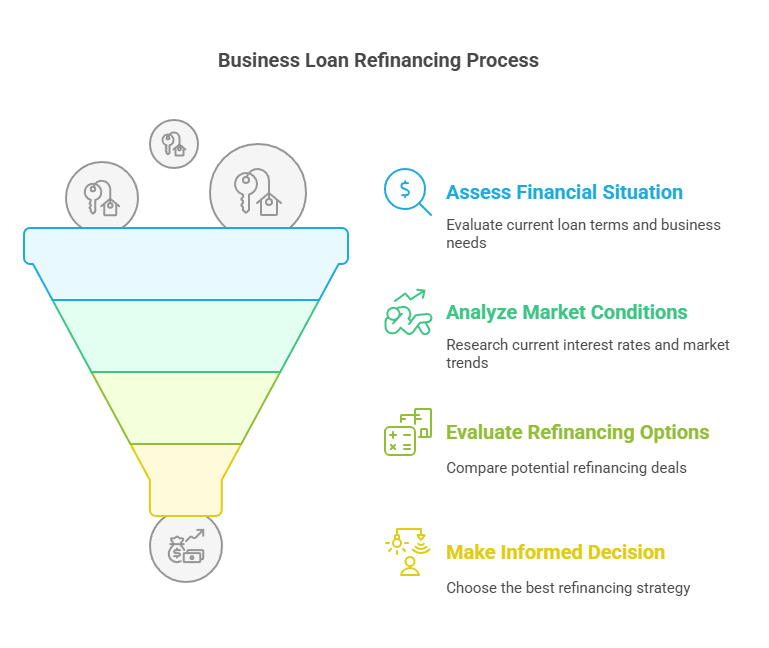
Refinancing is the process of replacing an existing loan with a new one, typically to secure more favorable terms. Think of it as upgrading your financial arrangement to better align with your current business situation and objectives.
When you refinance a business loan, you’re essentially paying off your original loan with funds from a new loan that offers improved conditions. These improvements might include a lower interest rate, different repayment schedule, reduced monthly payments, or access to additional capital.
For UK businesses, refinancing options have expanded significantly in recent years. Beyond traditional high street banks, alternative lenders, challenger banks, and fintech platforms now offer competitive refinancing solutions. This increased competition has created more opportunities for businesses to secure better terms.
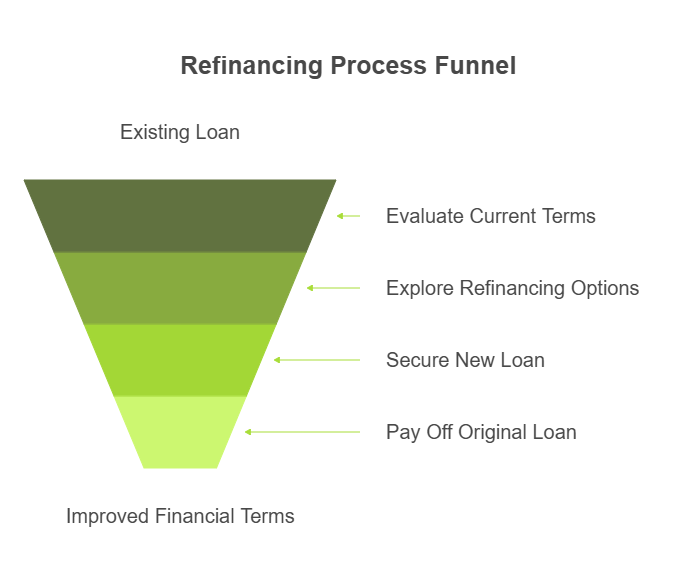
Refinancing differs from simply taking out a new loan because it specifically replaces existing debt rather than creating additional obligations. It’s a strategic financial move designed to optimize your debt structure rather than increase your overall borrowing.
The concept applies to virtually all types of business financing, including term loans, commercial mortgages, asset finance, equipment leasing, and even some types of invoice financing arrangements. Each type has its own refinancing considerations, but the fundamental goal remains the same: securing better terms that support your business objectives.
Learn more about the different types of business loans available
How Does Business Loan Refinancing Work in 7 Steps?
Understanding the refinancing process is essential for making informed decisions and maximizing the benefits for your business. Let’s break down the journey into manageable steps.
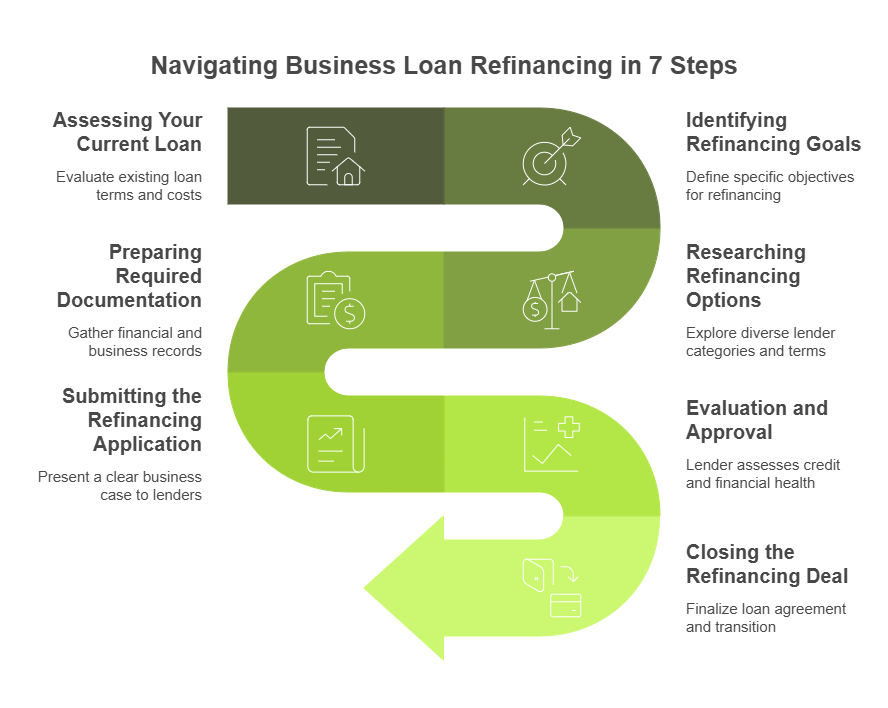
1. Assessing Your Current Loan
Before exploring refinancing options, you need a clear picture of your existing loan arrangement. This assessment establishes your baseline and helps determine whether refinancing makes financial sense.
Start by gathering your loan documentation and reviewing:
- Your current interest rate (is it fixed or variable?)
- The outstanding balance and remaining term
- Your monthly payment amount
- Any early repayment charges or exit fees
- Collateral requirements
- Covenants or restrictions that affect your business operations
Calculate the total cost of maintaining your current loan through its full term. How much interest will you pay over the remaining life of the loan? Are there any balloon payments or other special conditions to consider?
Also evaluate how your existing loan affects your cash flow. Does the payment schedule align well with your business’s revenue cycles? For seasonal businesses, this alignment can be particularly important.
“Many business owners don’t realize how much their original loan terms are costing them until they do this assessment,” notes Richard Thompson, business finance specialist at UK Finance Partners. “I’ve seen clients discover they could save tens of thousands of pounds through refinancing simply by running the numbers.”
Arrange your business loan refinancing through Guavas Finance – get business loan quotes today!
2. Identifying Refinancing Goals
Successful refinancing starts with clear objectives. What specifically do you hope to achieve? Your goals will guide your refinancing strategy and help you evaluate potential offers.
Common refinancing goals for UK businesses include:
- Reducing monthly payments to improve cash flow
- Securing a lower interest rate to save money over the loan term
- Shortening the loan term to become debt-free sooner
- Extending the loan term to reduce monthly financial pressure
- Converting from a variable to a fixed rate (or vice versa) based on market outlook
- Consolidating multiple loans into a single, manageable payment
- Releasing assets that are currently serving as collateral
- Accessing additional capital for business expansion or improvements
- Removing restrictive covenants that limit business operations
Prioritize these goals based on your business’s current needs and long-term strategy. Be realistic about what’s achievable given your business’s financial position and current market conditions.
Consider how these goals align with your broader business plan. If you’re planning significant growth in the next few years, improving cash flow might be more important than reducing the overall loan term. Conversely, if you’re preparing for retirement or sale of the business, paying down debt faster could be the priority.
Have you thought about which of these goals would most benefit your business right now? Taking time to clarify your priorities will help you make better decisions throughout the refinancing process.
3. Researching Refinancing Options
The UK lending market offers diverse refinancing options, each with distinct advantages and requirements. Cast a wide net to ensure you find the most competitive terms for your business.
Start by exploring these lender categories:
- Traditional high street banks (Barclays, HSBC, Lloyds, NatWest)
- Challenger banks (Metro Bank, Starling, OakNorth)
- Specialist business lenders (Funding Circle, iwoca, Fleximize)
- Peer-to-peer lending platforms (Funding Circle, ThinCats)
- Asset-based lenders for secured refinancing
- Government-backed schemes through the British Business Bank
Each lender category has its own approach. Traditional banks typically offer lower interest rates but have stricter eligibility criteria and longer application processes. Alternative lenders often provide faster decisions and more flexibility but may charge higher rates.
When comparing options, look beyond the headline interest rate to consider:
- Loan terms and repayment periods
- Fixed vs variable interest rates
- Arrangement fees and other charges
- Early repayment options and penalties
- Security requirements
- Covenants and restrictions
- Processing times and application complexity
- Customer service reputation and support
“The refinancing landscape in the UK has transformed dramatically in recent years,” explains James Wilson, commercial finance broker at Business Funding Solutions. “Many business owners still automatically approach their current bank, not realizing that specialist lenders might offer terms better suited to their specific industry or situation.”
Arrange your business loan refinancing through Guavas Finance – get business loan quotes today!
4. Preparing Required Documentation
Successful refinancing applications require thorough documentation that demonstrates your business’s financial health and ability to service the new loan. Preparing these documents in advance can streamline the application process and improve your chances of approval.
For UK businesses, typical documentation requirements include:
Business Financial Information:
- Business bank statements (typically for the last 3-6 months)
- Full annual accounts (for the last 2-3 years)
- Management accounts for the current financial year
- VAT returns (if VAT-registered)
- Corporation Tax returns
- Cash flow forecasts and projections
- Asset and liability statements
Business Information:
- Company registration documents
- Details of directors and significant shareholders
- Trading history
- Business plan (particularly important if refinancing for growth)
- Information about business premises (leased or owned)
Existing Loan Information:
- Current loan agreements
- Recent loan statements
- Details of any security or collateral
Personal Financial Information (for directors/guarantors):
- Personal bank statements
- SA302 tax calculations or tax year overviews
- Proof of identity and address
- Details of personal assets and liabilities
The specific requirements will vary by lender, with traditional banks typically requiring more extensive documentation than alternative lenders. Organize these documents systematically and ensure they present an accurate and positive picture of your business’s financial health.
If your business has experienced financial challenges, be prepared to explain these issues and demonstrate how they’ve been addressed. Lenders appreciate transparency and evidence of proactive financial management.
Arrange your business loan refinancing through Guavas Finance – get business loan quotes today!
5. Submitting the Refinancing Application
With your documentation prepared and refinancing options researched, you’re ready to submit your application. This process requires attention to detail and careful presentation of your business case.
Start by selecting the lender that best aligns with your refinancing goals and business profile. Consider submitting applications to multiple lenders within a short timeframe (typically two weeks) to minimize the impact on your credit score while maximizing your options.
When completing the application:
- Fill out all forms completely and accurately
- Provide all requested documentation in the format specified
- Include a cover letter or business case that clearly explains your refinancing goals
- Highlight improvements in your business’s financial position since taking out the original loan
- Address any potential concerns proactively with explanations and supporting evidence
Many UK lenders now offer online application processes that can significantly speed up submission. However, for complex refinancing situations, you might benefit from speaking directly with a business banking manager or relationship manager who can guide you through the process.
After submission, maintain open communication with the lender. Respond promptly to any requests for additional information or clarification. This demonstrates your professionalism and commitment to the refinancing process.
“The quality of your application can significantly impact both approval odds and the terms you’re offered,” advises Emma Roberts, former underwriter at a major UK bank. “Applications that clearly articulate the business case for refinancing and provide comprehensive, well-organized documentation tend to receive more favorable consideration.”
6. Evaluation and Approval
Once you’ve submitted your application, the lender will conduct a thorough evaluation to determine whether to approve your refinancing request and what terms to offer. Understanding this process can help you manage expectations and prepare for potential outcomes.
The evaluation typically includes:
Credit Assessment:
- Review of your business credit score from agencies like Experian or Creditsafe
- Analysis of your personal credit score (particularly for small businesses)
- Examination of payment history on existing loans and credit facilities
Financial Analysis:
- Assessment of business revenue and profitability trends
- Calculation of key financial ratios (debt service coverage ratio, debt-to-income ratio)
- Evaluation of cash flow stability and sustainability
Risk Assessment:
- Industry risk analysis
- Business model evaluation
- Assessment of collateral value (if applicable)
- Review of business longevity and market position
The evaluation timeline varies significantly between lenders, ranging from 24 hours with some online lenders to several weeks with traditional banks. During this period, the lender may request additional information or clarification on certain aspects of your application.
If approved, you’ll receive a formal offer outlining the terms of the new loan, including:
- Loan amount
- Interest rate
- Repayment term and schedule
- Any fees or charges
- Security requirements
- Specific conditions that must be met before closing
Review this offer carefully against your refinancing goals. Don’t hesitate to negotiate terms if they don’t fully meet your needs or if you’ve received more favorable offers from other lenders.
Arrange your business loan refinancing through Guavas Finance – get business loan quotes today!
7. Closing the Refinancing Deal
The final step in the refinancing process involves accepting the offer, completing the necessary paperwork, and transitioning from your old loan to the new one. This stage requires careful attention to detail to ensure a smooth transfer.
When closing the refinancing deal:
- Review the loan agreement thoroughly: Ensure all terms match what was offered and that you understand all obligations and restrictions. Consider having your accountant or solicitor review the documents.
- Satisfy any conditions precedent: Complete any requirements specified by the lender before the loan can be finalized, such as obtaining insurance or providing additional documentation.
- Sign the loan documents: This typically includes the loan agreement, security documents (if collateral is required), and various disclosures.
- Arrange for the payoff of your existing loan: The new lender will often handle this directly, but confirm the process to ensure your old loan is properly closed.
- Set up repayment mechanisms: Establish direct debits or other payment methods for your new loan.
- Update your financial records: Adjust your business’s financial projections and cash flow forecasts to reflect the new loan terms.
The closing process may involve fees such as arrangement fees, legal fees, or valuation fees. These should be clearly disclosed in your loan offer and factored into your refinancing decision.
Once the deal is closed, maintain copies of all documentation for your records. Update your financial management systems to reflect the new loan terms and payment schedule. Finally, consider setting calendar reminders for any key dates related to the new loan, such as rate review periods or balloon payment dates.
Arrange your business loan refinancing through Guavas Finance – get business loan quotes today!
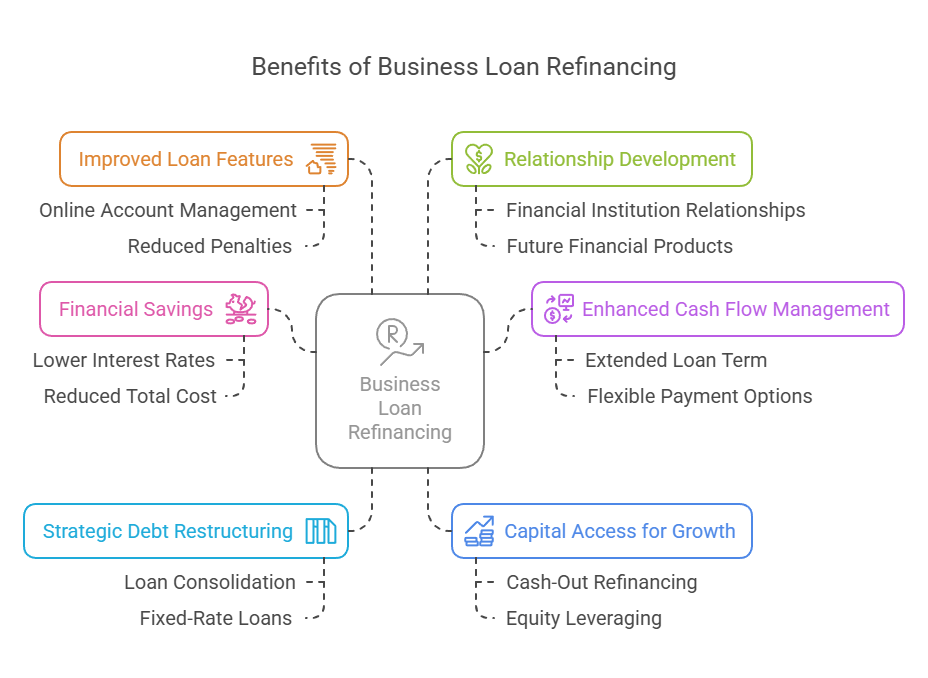
6 Benefits of Business Loan Refinancing
Refinancing your business loan can deliver numerous advantages that positively impact your company’s financial health and operational capabilities. Understanding these benefits will help you determine if refinancing aligns with your business objectives.
Financial Savings
Perhaps the most compelling reason to refinance is the potential for significant cost savings. Securing a lower interest rate can substantially reduce the total cost of borrowing over the life of your loan. For example, refinancing a £250,000 loan from 7% to 5.5% could save over £20,000 in interest over a five-year term.
Enhanced Cash Flow Management
Refinancing can transform your cash flow situation by restructuring your debt in alignment with your business’s revenue patterns. By extending your loan term or securing lower interest rates, you can reduce monthly payments, freeing up capital for day-to-day operations, unexpected expenses, or strategic investments.
For seasonal businesses, refinancing to a payment schedule that aligns with your high-revenue periods can be particularly valuable. Some lenders offer flexible repayment options that allow for lower payments during slow seasons and higher payments during peak periods.
Strategic Debt Restructuring
Beyond simple cost savings, refinancing allows you to strategically restructure your debt to better serve your business needs. You might consolidate multiple loans with varying terms and interest rates into a single, manageable loan with consistent payments. This simplification can reduce administrative burden and potentially lower your overall interest expenses.
Alternatively, you could shift from a variable-rate loan to a fixed-rate option, providing greater predictability for long-term financial planning—particularly valuable in times of economic uncertainty or rising interest rates.
Capital Access for Growth
Refinancing can be a vehicle for accessing additional capital beyond your current debt level. This cash-out refinancing approach allows you to tap into equity you’ve built in business assets or leverage improved business valuation to fuel expansion, fund major purchases, or invest in new opportunities without taking on entirely new debt instruments.
Improved Loan Features
Modern financing options often come with enhanced features and greater flexibility compared to older loans. Refinancing gives you access to these improvements, which might include:
- Online account management and payment systems
- More flexible payment options
- Reduced or eliminated early repayment penalties
- Removal of restrictive covenants that limit your business operations
- Better customer service and support
Relationship Development
The refinancing process can help you establish or strengthen relationships with financial institutions that may support your business’s future needs. Successfully refinancing demonstrates your business’s financial responsibility and can open doors to additional financial products and services as your business continues to grow.
Arrange your business loan refinancing through Guavas Finance – get business loan quotes today!
6 Factors to Consider Before Refinancing
While refinancing offers numerous potential benefits, it’s not always the right move for every business in every situation. Before proceeding, carefully evaluate these critical factors to ensure refinancing aligns with your business’s financial reality and long-term strategy.
Total Cost Analysis
Look beyond the monthly payment and interest rate to calculate the total cost of the new loan compared to your existing debt. Consider:
- Total interest paid over the full term
- Arrangement fees, legal fees, and valuation fees
- Early repayment charges on your existing loan
- Any ongoing administration fees
A lower interest rate doesn’t always guarantee overall savings, especially if fees are high or if you’re extending the loan term significantly. Create a comprehensive comparison that accounts for all costs associated with both your current loan and the potential new loan.
Business Stability and Trajectory
Assess your business’s current stability and future prospects honestly. Refinancing makes the most sense for businesses with:
- Stable or improving revenue
- Consistent profitability
- Strong cash flow management
- Clear growth trajectory
- Industry stability or growth
If your business is experiencing volatility or facing significant challenges, addressing these fundamental issues might be more important than refinancing existing debt. Lenders will scrutinize your business’s performance and stability, so be realistic about how your application will be perceived.
Market Timing
Consider the broader economic environment and interest rate trends. Refinancing during a period of rising interest rates might lock in a rate that’s higher than necessary. Conversely, in a falling rate environment, waiting too long could mean missing out on optimal terms.
Monitor Bank of England rate decisions and economic forecasts to inform your timing. While it’s impossible to perfectly predict interest rate movements, understanding the general direction can help you make more informed decisions about when to refinance.
Opportunity Cost
Evaluate what else you could do with the time and resources required for refinancing. The process demands significant attention from business owners and financial staff. Consider whether these resources might deliver greater value if directed toward other business priorities such as sales growth, operational improvements, or new product development.
For small businesses with limited administrative capacity, the refinancing process can be particularly demanding. Weigh the potential benefits against the time investment required.
Long-term Business Strategy
Align your refinancing decision with your long-term business strategy. If you’re planning to sell the business in the near future, taking on a new long-term loan might complicate matters. Similarly, if major changes in business structure or operations are imminent, these should factor into your refinancing approach.
Consider how long you intend to keep the debt and whether your business plans might require financial flexibility that could be limited by new loan terms or covenants.
Alternative Financing Options
Before committing to refinancing, explore whether other financing strategies might better serve your needs. Depending on your goals, options such as:
- Business lines of credit
- Invoice financing
- Asset-based lending
- Equity investment
- Government-backed loan schemes
might provide more appropriate solutions than traditional loan refinancing.
Explore alternative business financing options
When to Consider Refinancing Your Business Loans
Timing is crucial when it comes to refinancing. Identifying the optimal moment to refinance can significantly impact the benefits you receive. Here are key scenarios when refinancing deserves serious consideration.
Significant Interest Rate Drops
When market interest rates fall substantially below the rate on your existing loan, refinancing becomes particularly attractive. As a general rule, consider refinancing when you can secure a rate at least 1-2 percentage points lower than your current rate, though the exact threshold depends on your loan size and term.
The Bank of England’s base rate influences business loan rates across the UK market. Following significant base rate reductions, lenders typically adjust their offerings, creating refinancing opportunities for businesses with existing loans.
Improved Credit Profile
If your business credit score has improved significantly since you obtained your original loan, you may qualify for much better terms. Credit improvement can result from:
- Consistent, timely loan repayments
- Reduced overall debt levels
- Increased business revenue and profitability
- Longer trading history
- Resolved past credit issues
Many businesses secure their initial financing when they have limited trading history or during periods of financial strain. As your business establishes a stronger track record, lenders view you as lower risk, potentially offering substantially better terms.
Business Growth and Stability
Significant positive changes in your business’s financial situation often create ideal refinancing conditions. Consider refinancing when:
- Your revenue has increased substantially
- Profitability has improved
- Cash flow has stabilized
- You’ve acquired valuable assets
- Your business has reached important milestones
These improvements strengthen your refinancing application and can help you secure more favorable terms. Lenders are more willing to offer competitive rates to businesses demonstrating consistent growth and stability.
Need for Debt Consolidation
If your business has accumulated multiple loans, credit lines, or other financing products with different terms and payment schedules, refinancing to consolidate this debt can simplify your financial management and potentially reduce costs.
Debt consolidation through refinancing is particularly beneficial when:
- You’re managing multiple payment dates and amounts
- Your various debt instruments have significantly different interest rates
- Administrative costs of managing multiple loans are high
- Some loans have unfavorable terms that could be improved through consolidation
Access to Equity
As your business pays down debt and/or your business assets appreciate in value, you build equity that can be accessed through refinancing. Consider this option when:
- You need capital for business expansion
- Major equipment purchases are necessary
- You’re planning to acquire another business
- Renovations or relocations are required
- Working capital needs have increased
Cash-out refinancing allows you to tap into this equity while potentially improving your loan terms simultaneously.
Problematic Loan Terms or Covenants
Sometimes refinancing is driven less by interest rates and more by problematic terms in your existing loan. Consider refinancing if your current loan:
- Has restrictive covenants limiting business operations
- Includes personal guarantees you want to remove
- Requires collateral you’d prefer to release
- Contains balloon payments or other challenging structures
- Has an interest rate that’s about to adjust unfavorably (for variable-rate loans)
End of Fixed Rate Period
If you have a loan with an introductory fixed rate that’s about to expire, refinancing before transitioning to a potentially higher variable rate can lock in favorable terms for a new fixed period.
Arrange your business loan refinancing through Guavas Finance – get business loan quotes today!
5 Advantages of Refinancing Business Loans
Lower Interest Rates
Securing a lower interest rate is often the primary motivation for refinancing. Even a modest rate reduction can yield substantial savings over the life of your loan. For example, on a £500,000 loan with a 5-year term, reducing the interest rate from 6.5% to 5% would save approximately £38,000 in interest payments.
Lower rates become available to businesses for various reasons:
- General market interest rate decreases
- Improved business credit profile
- Stronger financial performance
- Increased competition among lenders
- Special lending programs or initiatives
When evaluating potential interest savings, calculate both the monthly payment reduction and the total interest saved over the full loan term. This comprehensive view helps you determine if refinancing makes financial sense.
“Many business owners focus solely on monthly payment reductions,” notes financial advisor David Williams. “But understanding the total interest savings over the life of the loan provides a clearer picture of refinancing’s true value.”
Improved Cash Flow
Cash flow is the lifeblood of any business, and refinancing can significantly improve your cash position through reduced monthly payments. This improvement can come from:
- Lower interest rates resulting in smaller payments
- Extended loan terms spreading payments over a longer period
- Restructured payment schedules that better align with your business cycles
The freed-up cash can be strategically deployed to:
- Build cash reserves for unexpected expenses
- Invest in growth opportunities
- Hire additional staff
- Increase inventory
- Upgrade equipment or technology
- Pay down other high-interest debt
For businesses experiencing cash flow pressure, refinancing can provide much-needed breathing room. Even companies with strong cash flow can benefit from the increased financial flexibility that comes with lower monthly obligations.
Debt Consolidation
Managing multiple business loans with different terms, payment dates, and interest rates can be administratively burdensome and financially inefficient. Refinancing to consolidate these debts offers several advantages:
- Simplified financial management with a single monthly payment
- Potential interest savings by eliminating higher-rate debts
- Reduced administrative costs and time spent managing multiple accounts
- Improved cash flow planning with consistent payment amounts and dates
- Opportunity to release multiple security arrangements into a single, cleaner structure
Debt consolidation through refinancing works best when you can secure a new loan with an interest rate lower than the weighted average of your existing debts. However, even at a similar rate, the administrative simplification can deliver significant benefits.
Access to Additional Capital
Refinancing can be structured to provide access to additional capital beyond what’s needed to pay off existing debt. This cash-out refinancing approach allows businesses to:
- Fund expansion projects
- Purchase new equipment or technology
- Acquire competitors or complementary businesses
- Renovate facilities
- Launch new products or services
- Increase working capital
For example, if your business has a £300,000 loan but your property has appreciated significantly, you might refinance with a £450,000 loan, paying off the original debt and accessing £150,000 for business investments.
This approach can be more cost-effective and straightforward than seeking separate additional financing, particularly when your business has built equity in assets or demonstrated improved financial performance.
Flexible Repayment Options
Modern business loans often offer more flexible repayment options than older loan products. Refinancing gives you access to these enhanced features, which might include:
- Seasonal payment adjustments for businesses with cyclical revenue
- Interest-only periods during specific business phases
- Payment holidays during predetermined circumstances
- Early repayment options without penalties
- Ability to make overpayments when cash flow allows
These flexible features can be particularly valuable for businesses with variable cash flow or those operating in seasonal industries. By aligning your debt obligations with your business’s unique financial patterns, you can reduce stress and improve overall financial management.
Arrange your business loan refinancing through Guavas Finance – get business loan quotes today!
6 Disadvantages of Refinancing Business Loans
Closing Costs and Fees
Refinancing isn’t free. Various costs and fees can significantly impact the overall value of refinancing. Common expenses include:
- Arrangement fees (typically 1-2% of the loan amount)
- Valuation fees for secured loans
- Legal fees for document preparation and review
- Early repayment charges on your existing loan
- Broker fees if using an intermediary
- Administration fees
These costs can add up quickly. On a £250,000 loan, fees might total £5,000-£10,000 depending on the complexity of the arrangement and the lenders involved.
To determine if refinancing makes financial sense despite these costs, calculate your break-even point—the time it will take for interest savings to offset the refinancing expenses. If you plan to maintain the loan beyond this break-even point, refinancing may still be worthwhile despite the upfront costs.
Extended Loan Term
Refinancing often involves extending the loan term to reduce monthly payments. While this improves short-term cash flow, it can significantly increase the total interest paid over the life of the loan.
For example, refinancing a £200,000 loan with 3 years remaining at 7% to a new 5-year loan at 5.5% would reduce monthly payments by approximately £1,700. However, you’d pay about £12,000 more in total interest due to the extended term.
Consider whether the immediate cash flow benefits outweigh the long-term cost increase. For businesses facing temporary cash flow challenges, the trade-off might be worthwhile. For those with strong cash positions, maintaining a shorter term while benefiting from lower rates could be more advantageous.
Prepayment Penalties
Many business loans include prepayment penalties or early repayment charges designed to compensate lenders for lost interest when loans are paid off before their scheduled term. These penalties can significantly impact the economics of refinancing.
Early repayment charges typically fall into one of these categories:
- Percentage of the loan balance (often 1-5%)
- Specified number of months’ interest
- Sliding scale that decreases over the loan term
- Fixed fee regardless of loan balance
Before refinancing, carefully review your existing loan agreement to understand any prepayment penalties. Factor these costs into your refinancing calculations to ensure the potential savings outweigh the penalties.
Some businesses choose to time their refinancing to coincide with penalty-free periods or when early repayment charges have stepped down to lower levels.
Impact on Credit Score
Refinancing involves applying for a new loan, which triggers a hard inquiry on your business credit report. This inquiry, along with the closure of your existing loan account and opening of a new credit account, can temporarily impact your business credit score.
While the effect is usually minor and short-lived for businesses with strong credit profiles, it’s worth considering if:
- You’re planning other financing applications in the near future
- Your business credit score is borderline for qualifying for favorable terms
- You’re concerned about maintaining specific credit rating thresholds
To minimize the impact, avoid making multiple loan applications over an extended period. Instead, concentrate your refinancing applications within a short timeframe (typically 14-30 days), as credit scoring models often treat these clustered inquiries as a single search for the best rate.
Risk of Unfavourable Market Conditions
Refinancing decisions are often based on current market conditions, which can change unexpectedly. Several risks to consider include:
- Interest rate increases before your refinancing is complete
- Economic downturns affecting lending appetite
- Industry-specific challenges that make lenders more cautious
- Regulatory changes impacting loan availability or terms
For example, a business that begins the refinancing process during favorable economic conditions might face very different lending terms if market sentiment shifts before completion. This risk is particularly relevant for complex refinancing arrangements that take longer to finalize.
To mitigate this risk, some lenders offer rate locks that guarantee specific terms for a defined period while you complete the refinancing process. These locks may involve a fee but provide protection against adverse market movements.
Loss of Favorable Loan Terms
Your existing loan might include valuable features that aren’t available or would be more expensive in a new loan. Consider whether refinancing would mean losing:
- Relationship-based pricing discounts
- Favorable security arrangements
- Unique flexibility provisions
- Grandfathered terms no longer offered in the market
- Special covenants or lack thereof that benefit your business
For instance, loans originated before certain regulatory changes might have more flexible terms than currently available products. Similarly, long-standing banking relationships sometimes include preferential treatment that wouldn’t transfer to a new lending arrangement.
Carefully review all aspects of your existing loan, not just the interest rate and payment amount, to ensure you’re not inadvertently giving up valuable features through refinancing.
Arrange your business loan refinancing through Guavas Finance – get business loan quotes today!
How to Refinance Your Business Loans in 8 Steps
Step 1: Evaluate Your Current Loan
Begin with a thorough assessment of your existing loan arrangement. This evaluation establishes your baseline and helps determine whether refinancing makes financial sense.
Gather your loan documentation and create a detailed profile of your current financing:
- Loan amount and outstanding balance
- Interest rate and whether it’s fixed or variable
- Monthly payment amount
- Remaining term
- Early repayment charges or exit fees
- Security arrangements and collateral requirements
- Covenants and restrictions
- Any special features or benefits
Calculate the total remaining cost of your current loan, including both principal and interest payments. This figure will serve as your comparison benchmark when evaluating refinancing options.
Also assess how well your current loan structure aligns with your business needs. Does the payment schedule work with your cash flow patterns? Are the covenants restricting your business operations? Understanding these qualitative factors is just as important as the quantitative analysis.
“Many business owners are surprised when they calculate the true cost of their existing loans,” says financial advisor Sarah Johnson. “One manufacturing client discovered they were paying nearly £45,000 more in interest than necessary due to outdated loan terms secured when their business was less established.”
Step 2: Determine Your Refinancing Goals
Clearly define what you hope to achieve through refinancing. Your specific goals will guide your refinancing strategy and help you evaluate potential offers.
Consider which of these objectives are most important to your business:
- Reducing monthly payments to improve cash flow
- Lowering the overall interest rate to save money
- Shortening the loan term to pay off debt faster
- Extending the loan term to reduce monthly financial pressure
- Switching from a variable to a fixed interest rate (or vice versa)
- Consolidating multiple loans into a single payment
- Releasing assets that are currently serving as collateral
- Accessing additional capital for business growth
- Removing restrictive covenants that limit business operations
Prioritize these goals based on your business’s current needs and long-term strategy. Be realistic about what’s achievable given your business’s financial position and current market conditions.
Document your goals with specific targets where possible. For example, rather than simply aiming to “reduce monthly payments,” set a target like “reduce monthly payments by at least £500 to support hiring an additional staff member.”
Have you considered how your refinancing goals align with your five-year business plan? This alignment ensures your financial decisions support your long-term vision rather than just addressing immediate concerns.
Step 3: Research Lenders and Loan Options
With clear goals established, it’s time to explore the UK lending market for refinancing options. Cast a wide net to ensure you find the most competitive terms for your business.
Research these lender categories:
Traditional Banks:
- High street banks like Barclays, HSBC, Lloyds, and NatWest
- Often offer competitive rates but have stricter criteria
- May provide relationship-based benefits for existing customers
- Typically have longer application processes
Challenger Banks:
- Newer institutions like Metro Bank, Starling, and OakNorth
- Often more technologically advanced with streamlined processes
- May offer more flexible criteria than traditional banks
- Competitive rates, particularly for stronger businesses
Specialist Business Lenders:
- Companies like Funding Circle, iwoca, and Fleximize
- Focus specifically on business lending
- Often more flexible with eligibility criteria
- May offer industry-specific expertise and tailored products
Asset-Based Lenders:
- Provide financing secured against business assets
- Can offer competitive rates for asset-rich businesses
- Particularly useful for manufacturing, wholesale, and retail sectors
- May allow higher loan-to-value ratios than traditional lenders
When comparing options, create a comprehensive comparison table that includes:
- Interest rates (APR/EAR)
- Loan terms and repayment periods
- Total cost of borrowing
- Arrangement fees and other charges
- Early repayment options and penalties
- Security requirements
- Application timelines
- Customer service reputation
Don’t limit your search to online research. Speak directly with lenders or use a business finance broker who can provide insights into which lenders might be most receptive to your specific situation.
Find a qualified UK business finance broker in your area
Step 4: Gather Necessary Documentation
Preparing thorough documentation in advance will streamline your refinancing application and improve your chances of approval. Lenders need comprehensive information to assess your creditworthiness and the viability of your refinancing request.
For UK businesses, prepare these essential documents:
Business Financial Information:
- Last 2-3 years of full annual accounts
- Recent management accounts
- Business bank statements (typically 3-6 months)
- VAT returns (if applicable)
- Corporation Tax returns
- Cash flow forecasts and projections
- Aged debtors and creditors reports
Business Information:
- Company registration documents
- Details of directors and significant shareholders
- Trading history summary
- Business plan (particularly important if refinancing for growth)
- Information about business premises (leased or owned)
Existing Loan Information:
- Current loan agreements
- Recent loan statements
- Details of any security or collateral
- Early repayment charge calculations
Personal Financial Information (for directors/guarantors):
- Personal bank statements
- SA302 tax calculations or tax year overviews
- Proof of identity and address
- Details of personal assets and liabilities
Organize these documents systematically and ensure they present an accurate and positive picture of your business’s financial health. Consider creating a digital folder structure that mirrors the lender’s application requirements for easy reference and sharing.
If your business has experienced financial challenges, prepare explanations that demonstrate how these issues have been addressed and what measures you’ve implemented to prevent recurrence. Lenders appreciate transparency and evidence of proactive financial management.
Step 5: Submit the Refinancing Application
With your documentation prepared and refinancing options researched, you’re ready to submit your application. This process requires attention to detail and careful presentation of your business case.
Start by selecting the lender that best aligns with your refinancing goals and business profile. Consider submitting applications to multiple lenders within a short timeframe (typically two weeks) to minimize the impact on your credit score while maximizing your options.
When completing the application:
- Fill out all forms completely and accurately
- Provide all requested documentation in the format specified
- Include a cover letter or business case that clearly explains your refinancing goals
- Highlight improvements in your business’s financial position since taking out the original loan
- Address any potential concerns proactively with explanations and supporting evidence
- Emphasize your business’s strengths and future prospects
Many UK lenders now offer online application processes that can significantly speed up submission. However, for complex refinancing situations, you might benefit from speaking directly with a business banking manager or relationship manager who can guide you through the process.
After submission, maintain open communication with the lender. Respond promptly to any requests for additional information or clarification. This demonstrates your professionalism and commitment to the refinancing process.
“The quality of your application can significantly impact both approval odds and the terms you’re offered,” advises Emma Roberts, former underwriter at a major UK bank. “Applications that clearly articulate the business case for refinancing and provide comprehensive, well-organized documentation tend to receive more favorable consideration.”
Step 6: Evaluation and Approval
Once you’ve submitted your application, the lender will conduct a thorough evaluation to determine whether to approve your refinancing request and what terms to offer. Understanding this process can help you manage expectations and prepare for potential outcomes.
The evaluation typically includes:
Credit Assessment:
- Review of your business credit score from agencies like Experian or Creditsafe
- Analysis of your personal credit score (particularly for small businesses)
- Examination of payment history on existing loans and credit facilities
- Assessment of overall debt levels and debt service ratios
Financial Analysis:
- Assessment of business revenue and profitability trends
- Calculation of key financial ratios (debt service coverage ratio, debt-to-income ratio)
- Evaluation of cash flow stability and sustainability
- Analysis of balance sheet strength and liquidity
Risk Assessment:
- Industry risk analysis and sector outlook
- Business model evaluation and competitive positioning
- Assessment of collateral value (if applicable)
- Review of business longevity and market position
- Management team experience and track record
The evaluation timeline varies significantly between lenders, ranging from 24 hours with some online lenders to several weeks with traditional banks. During this period, the lender may request additional information or clarification on certain aspects of your application.
If approved, you’ll receive a formal offer outlining the terms of the new loan, including:
- Loan amount
- Interest rate and whether it’s fixed or variable
- Repayment term and schedule
- Any fees or charges
- Security requirements
- Specific conditions that must be met before closing
Review this offer carefully against your refinancing goals. Don’t hesitate to negotiate terms if they don’t fully meet your needs or if you’ve received more favorable offers from other lenders. Many aspects of business loans are negotiable, particularly for businesses with strong financial profiles.
What questions should you ask about the offer? Consider:
- Are there any fees not disclosed in the initial offer?
- What flexibility exists for early repayment?
- Can payment terms be adjusted to match your business cycles?
- What happens if you need to adjust the loan in the future?
Compare business loan offers side by side before you commit
Step 7: Closing the Refinancing Deal
The final step in the refinancing process involves accepting the offer, completing the necessary paperwork, and transitioning from your old loan to the new one. This stage requires careful attention to detail to ensure a smooth transfer.
When closing the refinancing deal:
- Review the loan agreement thoroughly: Ensure all terms match what was offered and that you understand all obligations and restrictions. Consider having your accountant or solicitor review the documents before signing.
- Satisfy any conditions precedent: Complete any requirements specified by the lender before the loan can be finalized, such as obtaining insurance, providing additional documentation, or meeting specific financial covenants.
- Sign the loan documents: This typically includes the loan agreement, security documents (if collateral is required), personal guarantees (if applicable), and various disclosures. Ensure all signatures are properly executed and witnessed if required.
- Arrange for the payoff of your existing loan: The new lender will often handle this directly, but confirm the process to ensure your old loan is properly closed. Request a settlement statement from your existing lender showing the final payoff amount including any early repayment charges.
- Set up repayment mechanisms: Establish direct debits or other payment methods for your new loan. Confirm the first payment date and amount to ensure your accounting system is updated accordingly.
- Update your financial records: Adjust your business’s financial projections and cash flow forecasts to reflect the new loan terms. Ensure your accounting system properly records the new debt arrangement.
The closing process may involve fees such as arrangement fees, legal fees, or valuation fees. These should be clearly disclosed in your loan offer and factored into your refinancing decision. Some lenders allow these fees to be added to the loan amount rather than paid upfront.
Once the deal is closed, maintain copies of all documentation for your records. Update your financial management systems to reflect the new loan terms and payment schedule. Finally, consider setting calendar reminders for any key dates related to the new loan, such as rate review periods or balloon payment dates.
Browse more business finance guides
Step 8: Repay Existing Loan and Transition
The final step in the refinancing process involves ensuring your existing loan is properly closed and transitioning smoothly to your new financing arrangement. This critical phase requires attention to detail to avoid complications.
Confirming Loan Repayment:
Once your new loan is approved and funds are disbursed, verify that your previous loan has been fully repaid. Request written confirmation from your former lender that includes:
- Acknowledgment that the loan has been paid in full
- The final payoff amount
- Confirmation that all security interests have been released
- A statement that no further obligations exist
This documentation is crucial for your records and may be needed if any disputes arise in the future. Don’t assume the process has been completed correctly—actively confirm it.
Security Release:
If your previous loan was secured by business assets, property, or personal guarantees, ensure these security arrangements are properly released. This may involve:
- Obtaining formal deeds of release for any charges registered at Companies House
- Confirming the removal of any charges on property at the Land Registry
- Getting written confirmation that personal guarantees are no longer in effect
- Retrieving any physical collateral documents held by the previous lender
Failure to properly release security can create complications if you need to use those assets as collateral in the future or when selling the business.
Updating Financial Systems:
With the refinancing complete, update your internal financial systems to reflect the new loan arrangement:
- Adjust your accounting records to show the new loan balance and terms
- Update cash flow projections based on the new payment schedule
- Revise budget allocations if the refinancing has changed your monthly obligations
- Document any covenants or reporting requirements associated with the new loan
- Set up automated payment systems for the new loan
Informing Stakeholders:
Consider which stakeholders should be informed about your refinancing:
- Your accountant and financial advisors
- Key employees involved in financial management
- Business partners or investors
- In some cases, major customers or suppliers if the refinancing significantly impacts your business operations
Implementing Financial Strategy:
If your refinancing was part of a broader financial strategy, now is the time to implement the next steps:
- If you refinanced to improve cash flow, establish systems to track and deploy the freed-up capital
- If you accessed additional funds, execute your plan for using this capital effectively
- If you consolidated debt, ensure all previous credit lines are properly closed or managed
- If you refinanced to prepare for growth, begin implementing your expansion plans
Learning from the Process:
Finally, take time to reflect on the refinancing process. What went well? What could have been improved? Document these insights for future reference, as they’ll be valuable if you consider refinancing again in the future.
“The refinancing process doesn’t end when the new loan is in place,” explains financial consultant Michael Thompson. “The most successful businesses use refinancing as a catalyst for improved financial management and strategic growth. It’s not just about getting better loan terms—it’s about leveraging those terms to strengthen your business.”
Refinancing business loans can be a game-changer for entrepreneurs seeking to optimise their financial position. Throughout this article, we have explored various aspects of business loan refinancing, covering its definition, advantages, disadvantages, timing considerations, and the step-by-step process in the UK. By understanding the mechanics, evaluating the pros and cons, recognising key indicators, and following the refinancing guidelines, you can harness the power of refinancing to fuel business growth and enhance financial stability.
As a business owner, assessing your unique circumstances, financial goals, and market conditions is crucial when contemplating business loan refinancing. Consider consulting with financial professionals or advisors who can provide tailored guidance to your specific situation. With the proper knowledge and guidance, you can confidently navigate the refinancing landscape and make informed decisions that propel your business toward success. Refinancing is a strategic tool—when used wisely, it can unlock new opportunities and strengthen your business’s financial foundation.