
In today’s competitive business landscape, access to capital can make the difference between stagnation and spectacular growth. Corporate loans serve as a vital lifeline for businesses across the UK, providing the necessary funds to seize opportunities, navigate challenges, and fuel expansion plans.
Consider Brightstar Technologies, a mid-sized software company based in Manchester. After developing a groundbreaking cybersecurity solution, they faced a critical juncture: they needed £750,000 to scale their operations, hire specialized talent, and launch an international marketing campaign. Without sufficient cash reserves, their growth trajectory would stall, potentially allowing competitors to capture the market. Through a carefully structured term loan from a commercial lender, Brightstar secured the capital they needed, enabling them to triple their revenue within 18 months and establish themselves as industry leaders.
This scenario plays out daily across the UK business landscape. Whether you’re running a small enterprise looking to purchase essential equipment or a large corporation planning a major acquisition, understanding the corporate loan landscape is crucial to making informed financial decisions.
In this comprehensive guide, we’ll explore the various types of corporate loans available in the UK market, from simple overdrafts to complex syndicated facilities. We’ll examine how these loans are structured, repaid, and secured, providing you with the knowledge needed to navigate the corporate lending environment with confidence.
What is commercial and corporate loan funding?
Commercial loan funding represents a broad category of financial products designed specifically for businesses rather than individuals. These loans provide enterprises with access to capital for various purposes, including expansion, equipment purchases, working capital management, and strategic investments.
At its core, commercial loan funding is a formal agreement between a business entity and a lender, where the lender provides a specified amount of capital that the business agrees to repay according to predetermined terms. Unlike consumer loans, commercial funding typically involves larger sums, more complex structures, and different evaluation criteria focused on business performance rather than personal creditworthiness alone.
Commercial lenders in the UK include:
- Traditional banks (Barclays, HSBC, NatWest)
- Alternative lenders (ThinCats, iwoca, Funding Circle)
- Specialist financial institutions
- Government-backed schemes (Start Up Loans, Government Start Up Loan Scheme)
Each offers different advantages depending on your business circumstances. Traditional banks might provide lower interest rates but have stricter eligibility requirements, while alternative lenders might offer faster approval with higher costs.
The UK commercial lending market is substantial, with loans ranging from as little as £500 for microenterprises to multi-million pound facilities for large corporations. Mid-market loans typically fall between £1,000 and £750,000, while larger corporate financing often starts from £1 million upwards.
What distinguishes commercial loan funding from other financing options is its focus on business objectives and revenue-generating potential. When evaluating applications, lenders assess factors such as:
- Business trading history and financial performance
- Cash flow projections and repayment capacity
- Industry outlook and market position
- Management team experience and expertise
- Available collateral or security
- Purpose of the funding and potential return on investment
Have you considered how a strategic injection of capital could transform your business operations? Many entrepreneurs find that the right commercial loan can accelerate growth in ways that organic expansion simply cannot match.
Learn more about business cash flow management strategies
What types of corporate loans are there?
The corporate lending landscape offers a diverse array of financing solutions, each designed to address specific business needs and circumstances. Understanding the full spectrum of options available enables you to select the most appropriate funding mechanism for your particular situation.
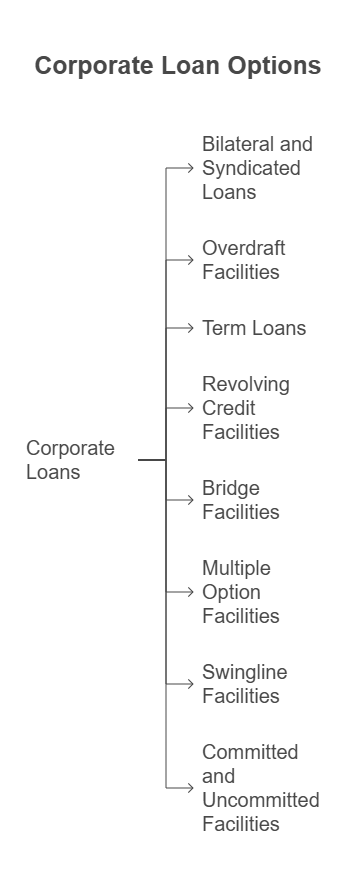
Corporate loans vary significantly in their structure, purpose, repayment terms, and eligibility requirements. Some are designed for short-term operational needs, while others support long-term strategic investments. Some require substantial security, while others focus more on cash flow and business performance.
The main categories of corporate loans include:
- Bilateral and syndicated loans – Arrangements with either a single lender or a group of lenders
- Overdraft facilities – Flexible short-term borrowing linked to business accounts
- Term loans – Fixed-amount loans repaid over a specified period
- Revolving credit facilities – Flexible borrowing up to a predetermined limit
- Bridge facilities – Short-term financing to “bridge” temporary gaps
- Multiple option facilities – Combined lending products offering various borrowing methods
- Swingline facilities – Ultra-short-term loans for immediate liquidity needs
- Committed and uncommitted facilities – Loans with different levels of lender obligation
Beyond these structural categories, corporate loans can also be classified by purpose (working capital loans, acquisition financing, equipment loans), security requirements (secured vs. unsecured), or duration (short, medium, or long-term).
The UK corporate lending market has evolved significantly in recent years, with alternative lenders challenging traditional banks by offering more flexible terms and faster approval processes. This increased competition has benefited businesses by expanding access to capital and driving innovation in lending products.
When evaluating which type of corporate loan best suits your needs, consider:
- How quickly you need the funds
- How long you need to borrow for
- Whether you have assets to offer as security
- The predictability of your cash flow
- The specific purpose of the funding
- Your tolerance for interest rate fluctuations
What is the difference between a bilateral loan and a syndicated loan?
The distinction between bilateral and syndicated loans lies primarily in the number of lenders involved and the complexity of the arrangement. This difference significantly impacts the loan’s structure, documentation, administration, and suitability for different business scenarios.
Bilateral loans involve just two parties: your business and a single lender. These one-to-one arrangements are typically more straightforward to negotiate and administer. The documentation is less complex, and you’ll deal with only one financial institution throughout the loan’s lifecycle. Bilateral loans are generally more appropriate for smaller to medium-sized funding requirements, usually up to several million pounds.
For example, a manufacturing company seeking £2 million to purchase new equipment would likely pursue a bilateral loan from their relationship bank. The process is relatively streamlined, with direct negotiations leading to a single loan agreement.
Syndicated loans, by contrast, involve multiple lenders collaborating to provide larger sums that might be too substantial or risky for a single institution to handle alone. A lead arranger (typically a bank) coordinates the process, bringing together a syndicate of lenders who each contribute a portion of the total loan amount. These arrangements are common for loans exceeding £10 million, though the threshold can vary depending on market conditions and sector.
Consider a retail chain planning a £50 million expansion across multiple locations. This substantial funding requirement might exceed what any single bank is willing to provide, making a syndicated loan the appropriate solution. The lead arranger would coordinate a group of banks, each contributing perhaps £5-10 million to the total facility.
Key differences include:
- Documentation complexity: Syndicated loans require more extensive documentation to address the relationships between multiple lenders
- Administration: Bilateral loans have simpler administration, while syndicated loans typically designate an agent bank to manage the facility
- Negotiation process: Bilateral loans involve direct negotiation with one lender; syndicated loans require coordination across multiple institutions
- Flexibility for changes: Modifying a bilateral loan requires agreement from one lender; syndicated loans need consent from multiple parties
- Relationship management: With bilateral loans, you maintain one banking relationship; syndicated loans involve multiple relationships
The choice between bilateral and syndicated structures depends primarily on the loan size, your company’s profile, and market conditions. Smaller and medium-sized enterprises typically utilize bilateral loans, while larger corporations or those undertaking significant projects often require syndicated facilities.
Compare corporate and commercial loan terms across a panel of funders with Guavas Finance.
What are overdrafts?
Overdraft facilities represent one of the most flexible and accessible forms of corporate financing available to UK businesses. An overdraft allows your company to withdraw funds beyond the actual balance in your business current account, up to a pre-approved limit. This creates a negative balance that you can draw upon as needed and repay when cash flow improves.
Find out everything you need to know about overdrafts here.
Overdrafts function as a financial safety net, providing immediate access to short-term funding without the formality and commitment of a traditional loan. They’re particularly valuable for managing day-to-day cash flow fluctuations, covering unexpected expenses, or bridging temporary gaps between receivables and payables.
The key characteristics of business overdrafts include:
- Flexibility: You only borrow what you need, when you need it
- Interest calculation: You only pay interest on the amount overdrawn, not the entire facility
- Availability: Funds are instantly accessible without additional approval processes
- Duration: Typically reviewed annually but can be renewed indefinitely
- Security requirements: May be secured or unsecured depending on the amount and lender’s assessment
For small to medium-sized businesses, overdraft limits typically range from £1,000 to £250,000, though larger corporations may negotiate facilities into the millions. The interest rates are usually variable and expressed as a percentage over the Bank of England base rate.
Consider a seasonal business like a holiday cottage rental agency. During winter months, bookings and cash flow might be minimal, while fixed costs like maintenance and staff remain constant. An overdraft facility allows the business to cover these expenses during the low season, then repay the borrowed amount during the summer peak when revenue increases substantially.
While overdrafts offer significant advantages in terms of flexibility, they also come with potential drawbacks:
- Higher interest rates compared to some term loans
- Potential for fees, including arrangement fees and non-utilization fees
- The bank’s right to demand repayment or reduce the facility limit with minimal notice
- The temptation to rely on the overdraft for long-term financing needs
To use an overdraft effectively:
- Negotiate the most favorable terms possible, including competitive interest rates and minimal fees
- Establish a limit that provides adequate cushion without encouraging unnecessary borrowing
- Monitor your usage regularly to avoid exceeding the approved limit
- Use the facility strategically for short-term needs rather than long-term financing
- Maintain open communication with your bank about your business performance and needs
What are term loans for corporate loans?
Term loans represent the most traditional and straightforward form of corporate borrowing. These loans provide a fixed amount of capital upfront, which your business repays over a predetermined period through regular installments that typically include both principal and interest.
The defining characteristic of term loans is their structured repayment schedule. Unlike revolving facilities or overdrafts, term loans follow a clear amortization path from disbursement to full repayment. This predictability makes them particularly suitable for specific investments with quantifiable returns and defined timeframes.
Term loans in the UK corporate lending market generally fall into three categories:
- Short-term loans: Repayment periods of up to 3 years, often used for working capital, inventory purchases, or smaller equipment acquisitions
- Medium-term loans: Repayment periods of 3-7 years, commonly used for equipment financing, technology investments, or business expansion
- Long-term loans: Repayment periods of 7-25 years, typically used for major capital expenditures, property purchases, or significant business acquisitions
The structure of a term loan provides several advantages for businesses:
- Predictable repayments: Fixed installments make budgeting and cash flow forecasting more straightforward
- Lower interest rates: Compared to overdrafts or credit cards, term loans generally offer more competitive rates
- Tailored terms: Loan duration can be matched to the useful life of the asset being financed
- Tax efficiency: Interest payments on business loans are typically tax-deductible
- Relationship building: Successfully managing a term loan can strengthen your banking relationship
For example, a manufacturing company might secure a 5-year term loan of £500,000 to purchase specialized machinery. The loan would be structured with monthly repayments calculated to fully amortize the debt over the 5-year period, with interest rates either fixed for certainty or variable to potentially benefit from future rate decreases.
Term loans can feature various interest rate structures:
- Fixed rate: The interest rate remains constant throughout the loan term
- Variable rate: The interest rate fluctuates based on a reference rate (like SONIA or the Bank of England base rate)
- Hybrid structures: Fixed for an initial period, then converting to variable
Security requirements for term loans vary based on the loan amount, your business’s financial strength, and the lender’s risk appetite. Smaller loans to established businesses might be unsecured, while larger amounts typically require specific collateral or general charges over business assets.
When considering a term loan, pay particular attention to:
- The total cost of borrowing, including arrangement fees and early repayment charges
- Interest rate structure and potential for rate increases if variable
- Covenants that might restrict certain business activities
- Prepayment options and associated penalties
- The alignment between the loan term and the useful life of what you’re financing
What are revolving credit facilities?
Revolving credit facilities (RCFs) offer businesses a flexible borrowing arrangement that combines the accessibility of an overdraft with the structure of a formal loan agreement. These facilities provide access to a predetermined credit limit that can be drawn down, repaid, and redrawn multiple times during the facility’s term, giving businesses remarkable adaptability in managing their financing needs.
Unlike term loans where you receive the entire amount upfront, revolving credit facilities allow you to borrow only what you need, when you need it, up to your approved limit. This “revolving” nature means that as you repay borrowed funds, that credit becomes available again for future use without requiring a new loan application.
The key features of revolving credit facilities include:
- Flexible drawdowns: Borrow funds as needed, often with minimal notice requirements
- Interest efficiency: Pay interest only on the amount actually borrowed, not the entire facility
- Repayment flexibility: Make repayments at any time to reduce interest costs
- Availability period: Typically established for 1-5 years, with potential for renewal
- Commitment fees: Usually include fees on the undrawn portion of the facility
Revolving credit facilities are particularly valuable for businesses with fluctuating cash flow needs or those requiring ongoing access to working capital. For instance, a wholesale distributor might use an RCF to finance inventory purchases ahead of peak selling seasons, then repay the borrowed amounts as customer payments come in.
The structure of revolving credit facilities can vary significantly:
- Secured vs. unsecured: Larger facilities typically require security, while smaller ones might be unsecured for creditworthy businesses
- Bilateral vs. syndicated: Smaller facilities are usually bilateral, while larger ones may involve multiple lenders
- Standalone vs. part of a wider banking package: Often included alongside other banking services
Consider a technology company that secures a £2 million revolving credit facility with a 3-year term. During product development phases, they might draw down £500,000 to cover R&D costs. After launching the product and generating revenue, they repay that amount, making the full £2 million available again for the next development cycle.
When evaluating revolving credit facilities, businesses should consider:
- Interest rate structure: Usually variable, expressed as a margin over a reference rate like SONIA
- Fee components: Including arrangement fees, commitment fees on undrawn amounts, and potentially non-utilization fees
- Covenant package: Financial ratios and other restrictions you must maintain
- Drawdown mechanics: How quickly and easily you can access funds when needed
- Renewal prospects: The likelihood of extending the facility beyond its initial term
To maximize the benefits of a revolving credit facility:
- Draw funds only when necessary to minimize interest costs
- Time repayments strategically to reduce average borrowings
- Monitor covenant compliance carefully to avoid default scenarios
- Maintain open communication with lenders about changing business needs
What are bridge facilities?
Bridge facilities, also known as bridge loans or interim financing, provide temporary funding to “bridge” the gap between immediate capital needs and longer-term financing solutions. These short-term facilities enable businesses to seize time-sensitive opportunities or meet urgent obligations while arranging more permanent funding structures.
The defining characteristic of bridge facilities is their temporary nature. They typically have terms ranging from a few weeks to 18 months, with the expectation that they will be repaid through a specific identified source of funds, such as a term loan, property sale, or equity investment.
Bridge facilities serve various purposes in the corporate finance landscape:
- Acquisition financing: Enabling companies to complete acquisitions quickly while arranging permanent financing
- Property transactions: Funding property purchases before long-term mortgage financing is secured
- Project initiation: Covering initial costs of projects until long-term funding is arranged
- Working capital gaps: Addressing temporary but significant working capital shortfalls
For example, a retail business might identify an opportunity to acquire a competitor at an attractive price, but the deal requires completion within 30 days. A bridge facility could provide the necessary funds to close the acquisition, giving the company time to arrange a more suitable long-term financing solution.
The key features of bridge facilities include:
- Speed of execution: Often arranged and funded within days rather than weeks
- Higher interest rates: Reflecting the short-term nature and increased risk
- Clear exit strategy: Defined source of repayment identified at the outset
- Flexible structures: Tailored to the specific situation and repayment source
- Security requirements: Typically secured against specific assets or the entire business
Bridge facilities in the UK market typically range from £250,000 to tens of millions of pounds, depending on the size and needs of the business. Interest rates are generally higher than for term loans, reflecting the increased risk and short-term nature of the facility.
When considering a bridge facility, businesses should carefully evaluate:
- The certainty of the repayment source
- The total cost, including arrangement fees and exit fees
- The consequences if the anticipated repayment source fails to materialize
- Alternative financing options that might be more cost-effective
- The lender’s experience with similar bridge transactions
What are multiple option facilities?
Multiple option facilities (MOFs) represent a sophisticated approach to corporate financing, offering businesses access to various types of credit instruments under a single agreement. This versatile arrangement allows companies to utilize different borrowing methods based on their changing needs without negotiating separate facilities.
A multiple option facility typically combines several of the following credit options:
- Term loans for specific investments
- Revolving credit for fluctuating working capital needs
- Overdraft facilities for day-to-day cash management
- Guarantee facilities for providing performance or payment guarantees
- Foreign exchange facilities for managing currency risks
The primary advantage of a multiple option facility is its flexibility. Rather than maintaining separate agreements for different financing needs, businesses can access various credit instruments through a single facility with a combined limit. This streamlines administration, potentially reduces overall fees, and allows for more efficient use of available credit.
For instance, a manufacturing business with a £5 million multiple option facility might use £2 million as a term loan to purchase equipment, £1.5 million as a revolving credit facility for raw materials, and keep £1.5 million available for guarantees required by overseas suppliers or customers.
Key characteristics of multiple option facilities include:
- Umbrella limit: An overall credit limit that applies across all borrowing options
- Sub-limits: Specific limits for each type of borrowing within the overall facility
- Flexible utilization: Ability to switch between different borrowing methods as needs change
- Consolidated documentation: A single agreement covering all borrowing options
- Unified security package: Typically secured by a common set of assets or guarantees
Multiple option facilities are particularly valuable for businesses with diverse and changing financing needs. They’re commonly used by:
- Companies with seasonal business cycles requiring different types of financing throughout the year
- Businesses engaged in international trade needing various trade finance instruments
- Growing companies whose financing needs evolve as they expand
- Enterprises with project-based revenue streams and varying cash flow patterns
When evaluating a multiple option facility, consider:
- The appropriateness of the overall limit and sub-limits for your business needs
- The interest rates and fees applicable to each component of the facility
- The flexibility to adjust sub-limits as your business requirements change
- The security requirements and covenant package
- The lender’s experience in managing complex facilities
While multiple option facilities offer significant advantages, they can be more complex to manage than single-purpose loans. Effective utilization requires careful monitoring of each component and strategic planning to optimize the overall facility.
What are swingline facilities in corporate loans?
Swingline facilities are specialized short-term lending arrangements designed to provide businesses with rapid access to funds, typically within a matter of hours. These facilities function as a subset of larger credit arrangements, offering a mechanism for addressing immediate liquidity needs or capitalizing on time-sensitive opportunities.
Originally developed in the United States and now widely available in the UK market, swingline facilities derive their name from the quick “swing” of funds from lender to borrower. They’re particularly valuable in situations where standard drawdown procedures would be too slow to meet urgent funding requirements.
The key features of swingline facilities include:
- Ultra-short notice periods: Funds can typically be accessed with notice periods as short as 1-4 hours
- Short-term duration: Borrowings are generally expected to be repaid within a few days to a few weeks
- Limited size: Usually capped at a portion of a larger revolving credit facility
- Streamlined drawdown process: Simplified procedures to enable rapid access to funds
- Designated swingline lenders: Specific lenders within a syndicate who agree to provide this rapid funding
Swingline facilities are commonly embedded within larger revolving credit facilities, particularly in syndicated loan arrangements. For example, a company might have a £20 million revolving credit facility with a £5 million swingline component that can be accessed on short notice.
These facilities serve various purposes in corporate finance:
- Meeting unexpected payment obligations: Covering urgent supplier payments or tax liabilities
- Addressing technical banking delays: Bridging gaps caused by clearing or settlement delays
- Capitalizing on time-sensitive opportunities: Funding immediate business opportunities requiring quick action
- Managing intra-day liquidity: Ensuring sufficient funds are available throughout the business day
For instance, a UK-based import business might use a swingline facility to make an immediate payment to secure a discounted shipment of goods that becomes unexpectedly available, even if their regular funding wouldn’t be accessible until the following day.
When considering a swingline facility, businesses should evaluate:
- The additional cost compared to standard borrowing options
- The notice period required to access funds
- The maximum amount available under the swingline component
- The repayment expectations and consequences of extended usage
- The administrative procedures for requesting and receiving funds
While swingline facilities provide valuable flexibility, they should be used judiciously. Their purpose is to address genuine short-term needs rather than to compensate for inadequate cash flow planning or to fund long-term requirements.
Committed and uncommitted facilities for corporate loans
The distinction between committed and uncommitted facilities represents a fundamental aspect of corporate lending that significantly impacts the certainty and cost of borrowing. Understanding this distinction is crucial for businesses seeking to establish an appropriate financing structure.
Committed facilities are legally binding arrangements where the lender is contractually obligated to provide funds (subject to the borrower meeting specified conditions) throughout the facility’s term. This commitment gives businesses certainty that the funding will be available when needed, regardless of changes in market conditions or the lender’s circumstances.
Key characteristics of committed facilities include:
- Legal obligation: The lender must honor drawdown requests that comply with the facility terms
- Commitment fees: Borrowers typically pay fees on the undrawn portion to compensate the lender for reserving the funds
- Detailed documentation: More comprehensive loan agreements with clearly defined terms and conditions
- Covenant package: Financial and operational covenants that the borrower must maintain
- Defined term: A specific availability period during which the commitment applies
Uncommitted facilities, by contrast, represent an agreement in principle where the lender is willing to consider providing funds but retains the discretion to decline individual drawdown requests. These facilities offer greater flexibility for the lender and typically come with lower or no commitment fees, but provide less certainty for the borrower.
Characteristics of uncommitted facilities include:
- Lender discretion: Each drawdown request is subject to lender approval at that time
- Reduced or no commitment fees: Lower cost of maintaining the facility when not in use
- Simpler documentation: Less comprehensive agreements with fewer restrictive covenants
- Potential for immediate cancellation: The lender can typically withdraw the facility at short notice
- Often relationship-driven: Approval decisions may depend on the overall banking relationship
The choice between committed and uncommitted facilities involves a trade-off between certainty and cost. Consider a manufacturing business planning a major equipment purchase. With a committed facility, they can proceed with confidence that the funding will be available when needed, even if market conditions deteriorate. With an uncommitted facility, they face the risk that the funding might not be available when required, potentially jeopardizing the purchase.
Common examples of committed facilities include:
- Term loans with fixed repayment schedules
- Revolving credit facilities with defined availability periods
- Project finance facilities with long-term commitments
Typical uncommitted facilities include:
- Overdraft facilities subject to regular review
- Short-term working capital lines
- Trade finance facilities reviewed on a transaction basis
When deciding between committed and uncommitted facilities, businesses should consider:
- The criticality of funding availability to their operations or strategic plans
- Their willingness to pay commitment fees for certainty
- The strength of their relationship with potential lenders
- Market conditions and the potential for future credit tightening
- The purpose of the funding and the consequences if it becomes unavailable
See how the main business loan types compare, or read our guide to secured vs unsecured business loans.
How commercial loans are repaid
The repayment structure of commercial loans is a critical consideration for businesses, directly impacting cash flow, financial planning, and overall business strategy. Different loan types feature varying repayment mechanisms, each with distinct advantages and considerations.
Term loans typically follow one of several repayment structures:
- Amortizing repayments: Equal periodic payments (usually monthly) comprising both principal and interest, with the proportion of principal increasing over time. This structure provides predictability for cash flow planning.
- Interest-only with bullet repayment: Regular interest payments throughout the loan term, with the entire principal repaid in a single “bullet” payment at maturity. This structure minimizes periodic payments but requires planning for the substantial final payment.
- Stepped repayments: Payments that increase or decrease at predetermined intervals, often aligned with expected changes in the business’s cash flow or profitability.
- Seasonal repayments: Payment schedules tailored to businesses with seasonal revenue patterns, with higher payments during peak periods and reduced payments during off-seasons.
Revolving credit facilities and overdrafts typically require:
- Interest payments: Regular payments of interest on the outstanding balance
- Periodic clean-down: Some facilities require the balance to be fully repaid for a short period (e.g., 30 days) during each year to demonstrate that the borrowing is not permanent
- Reduction in limits: Facilities may include step-down provisions where the available credit gradually reduces over time
For example, a retail business might arrange a term loan with seasonal repayments, with lower installments during slower winter months and higher payments during the busy summer and Christmas periods. This alignment with cash flow patterns reduces financial stress during quieter trading periods.
When structuring loan repayments, businesses should consider:
- Cash flow alignment: Ensure repayment schedules match your projected cash flow patterns
- Headroom maintenance: Build in sufficient headroom to accommodate unexpected fluctuations
- Early repayment options: Understand any penalties or benefits associated with repaying ahead of schedule
- Refinancing opportunities: Consider potential for refinancing if interest rates decrease significantly
- Tax implications: Evaluate the tax treatment of different repayment structures
Read how business loan refinancing works
Most UK lenders offer some flexibility in repayment structures, particularly for larger loans to established businesses. Don’t hesitate to negotiate terms that align with your business’s specific circumstances and cash flow patterns.
Have you analyzed your business’s cash flow cycle to determine the optimal repayment structure? Taking the time to align loan repayments with your revenue patterns can significantly reduce financial stress and improve overall business stability.
What security your bank may want
When providing corporate loans, lenders typically seek security to mitigate their risk and ensure they have recourse if the borrower defaults. The type and extent of security required depends on various factors, including the loan amount, the borrower’s financial strength, and the purpose of the financing.
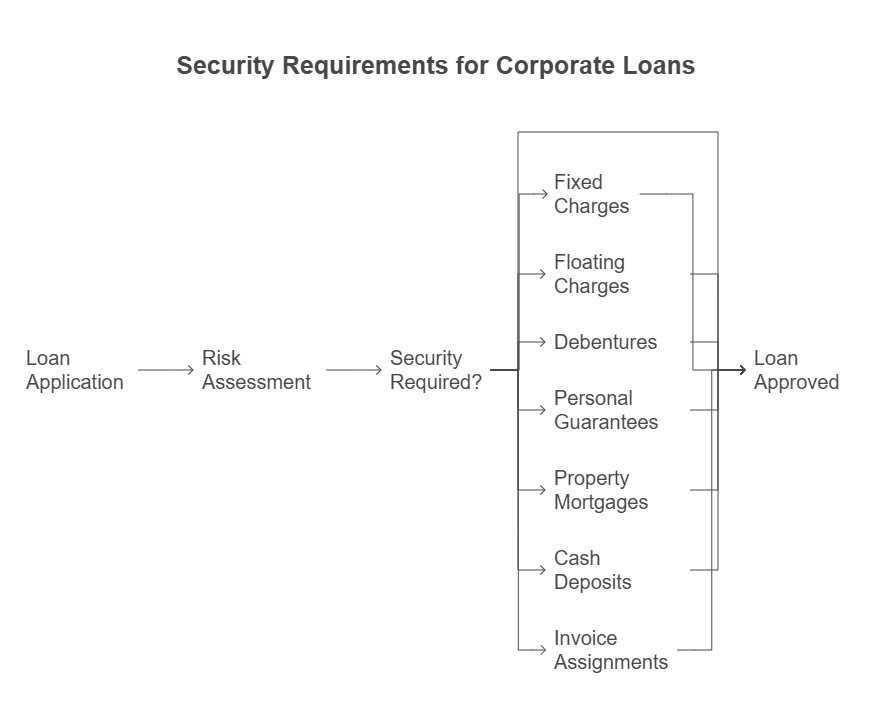
Common forms of security requested by UK lenders include:
- Fixed charges: Legal claims over specific assets such as property, equipment, or vehicles. Fixed charges give lenders priority over these assets in case of default.
- Floating charges: Security over classes of assets (such as inventory or receivables) that can change in composition over time. Floating charges “crystallize” into fixed charges upon certain trigger events, such as default.
- Debentures: Documents that create both fixed and floating charges over a company’s assets, effectively securing all or most of the business’s property.
- Personal guarantees: Commitments from directors or shareholders to personally repay the loan if the business cannot. These extend the lender’s recourse beyond the company’s assets to the guarantor’s personal assets.
- Property mortgages: Specific security over real estate, whether commercial or residential property owned by the business or its directors.
- Cash deposits: Funds held in restricted accounts as security for the loan.
- Invoice assignments: Legal assignments of the right to receive payment from specific customer invoices.
The level of security required typically correlates with the perceived risk of the loan. For example, a well-established profitable business might secure a £100,000 loan with just a floating charge, while a startup seeking the same amount might need to provide fixed charges over all assets plus personal guarantees from directors.
When negotiating security requirements, consider:
- Proportionality: The security should be proportionate to the loan amount and risk
- Impact on operations: Ensure security arrangements don’t unduly restrict normal business activities
- Release mechanisms: Clarify how and when security will be released as the loan is repaid
- Personal exposure: Carefully evaluate the implications of providing personal guarantees
- Existing charges: Consider how new security will interact with any existing charges
It’s worth noting that some UK lenders offer unsecured lending options for smaller amounts (typically up to £25,000) to businesses with strong credit profiles. These loans may carry higher interest rates but avoid the complexity and restrictions associated with secured lending.
Remember that security requirements are often negotiable, particularly for businesses with strong financial performance or valuable banking relationships. Don’t hesitate to discuss alternatives if the proposed security seems excessive for your circumstances.
Browse Types of Business Loans Explained here.
Corporate Loan Application Process
Securing a corporate loan requires careful preparation and a structured approach. Understanding the application process helps businesses present themselves effectively to potential lenders and increases the likelihood of approval on favorable terms.
The typical corporate loan application process in the UK follows these steps:
1. Preparation and Planning
Before approaching lenders, thoroughly assess your financing needs and prepare essential documentation:
- Determine the precise amount required and how it will be used
- Gather financial statements (typically 2-3 years)
- Prepare cash flow forecasts demonstrating repayment capacity
- Compile management accounts and business plans
- Organize asset valuations if offering specific security
This preparation phase is crucial. Have you clearly defined how the loan will generate returns sufficient to cover repayments? Lenders will scrutinize this aspect carefully.
2. Lender Research and Selection
Research potential lenders to identify those most suitable for your specific needs:
- Traditional banks often offer competitive rates but may have stricter criteria
- Alternative lenders might provide more flexible terms but at higher costs
- Specialist lenders focus on specific industries or loan purposes
- Government-backed schemes may offer favorable terms for qualifying businesses
Consider factors beyond just interest rates, such as the lender’s industry expertise, reputation for supporting businesses through challenges, and additional services offered.
3. Initial Approach and Discussion
Contact selected lenders to discuss your requirements:
- Present a concise overview of your business and funding needs
- Be prepared to answer detailed questions about your business model
- Discuss potential loan structures and security requirements
- Obtain indicative terms for comparison
This initial discussion helps establish whether the lender is a good fit before investing significant time in a formal application.
4. Formal Application Submission
Submit a comprehensive loan application including:
- Completed application forms
- Business plan and purpose of the loan
- Historical financial statements
- Financial projections and repayment plans
- Details of offered security
- Information about management team experience
- Market analysis and competitive positioning
The quality and thoroughness of this submission significantly impact the lender’s perception of your business’s professionalism and creditworthiness.
5. Due Diligence and Assessment
The lender will conduct thorough due diligence, which may include:
- Analyzing financial statements and projections
- Conducting credit checks on the business and key directors
- Verifying assets offered as security
- Assessing industry conditions and market outlook
- Reviewing existing debt obligations and financial commitments
- Evaluating management team experience and track record
- Conducting site visits to business premises
This assessment phase typically takes 2-6 weeks depending on the complexity of the application and the lender’s processes. During this period, be prepared to respond promptly to requests for additional information or clarification, as delays can negatively impact the application.
6. Credit Approval and Offer
If the application passes the lender’s assessment criteria, they will issue a formal offer letter or term sheet outlining:
- Loan amount and purpose
- Interest rate and fee structure
- Repayment terms and schedule
- Security requirements
- Covenants and conditions
- Reporting requirements
- Default provisions
Review this document carefully, ideally with professional advisors, to ensure you fully understand all terms and conditions. Don’t hesitate to negotiate aspects that seem unreasonable or problematic for your business operations.
7. Documentation and Legal Process
Once terms are agreed, the lender will prepare formal loan documentation:
- Facility agreement detailing all terms and conditions
- Security documents for any assets pledged
- Personal guarantee forms if required
- Debentures or charges over company assets
- Board resolutions authorizing the borrowing
This legal phase may involve solicitors representing both parties and can take several weeks to complete, particularly for complex or large facilities. Budget for legal costs, which can be substantial for larger loans.
8. Completion and Drawdown
After all documentation is executed and conditions precedent are satisfied:
- Security registrations are completed at Companies House
- Funds become available for drawdown according to the agreed terms
- Initial fees are typically deducted from the first drawdown
- Ongoing relationship management processes are established
The entire process from initial preparation to drawdown typically takes 6-12 weeks for standard corporate loans, though this can vary significantly based on complexity, loan size, and lender efficiency.
Tips for a Successful Application for Corporate Loans
- Be transparent: Disclose all relevant information, even potential challenges. Lenders value honesty and will likely discover issues during due diligence anyway.
- Demonstrate affordability: Provide robust evidence that your business can comfortably service the debt under various scenarios, including potential downturns.
- Present professionally: Well-organized, professional documentation creates a positive impression and suggests your business is well-managed.
- Anticipate questions: Prepare answers to likely questions about your business model, market position, and how you’ll use and repay the loan.
- Build relationships: Establish rapport with your banking contacts; a strong relationship can make the difference in borderline decisions.
Remember that lenders are assessing not just financial metrics but also the quality and credibility of the management team. Your ability to articulate a clear vision and demonstrate thorough understanding of your business and market significantly influences lending decisions.
Commercial loans play a vital role in the financial landscape for businesses in the United Kingdom. Throughout this article, we have explored various sub-topics, ranging from the introduction to commercial loans, their distinctions from other business loans, the advantages and disadvantages they offer, and the process of qualifying and applying for these loans. By understanding the intricacies of commercial loans, business owners can make well-informed decisions when financing their ventures.
Commercial loans provide businesses access to substantial capital, fund allocation flexibility, and growth and expansion opportunities. They offer advantages such as longer repayment terms, more significant loan amounts, and the ability to address various financial needs. However, it is essential to consider the potential drawbacks, including collateral requirements, debt burdens, and interest rates.
To qualify for a commercial loan, businesses must demonstrate creditworthiness, provide comprehensive financial documentation, and present a well-structured business plan. By following the application process diligently, responding promptly to lender inquiries, and seeking professional guidance when necessary, business owners can enhance their chances of loan approval.
When you are ready to compare corporate loan terms across a panel of funders, get a quote or read more about business loans with Guavas.