
In today’s competitive business landscape, access to capital can make the difference between stagnation and growth so let’s consider the different types of business loans. Whether you’re launching a startup, expanding operations, or managing cash flow challenges, understanding the various business loan options available in the UK is crucial for making informed financial decisions.
Consider James, who runs a small manufacturing business in Leeds. When a major retailer approached him with an order that would double his annual revenue, he faced a dilemma. The opportunity required immediate investment in additional equipment and inventory, but his cash reserves weren’t sufficient. By securing the right type of business loan, James was able to fulfill the order, which became the cornerstone of his company’s expansion into new markets.
The UK financing landscape offers numerous solutions tailored to different business needs and circumstances. From traditional bank loans to innovative alternative financing options, each serves a specific purpose and comes with its own advantages and considerations. This guide will help you navigate these options to find the perfect funding solution for your business.
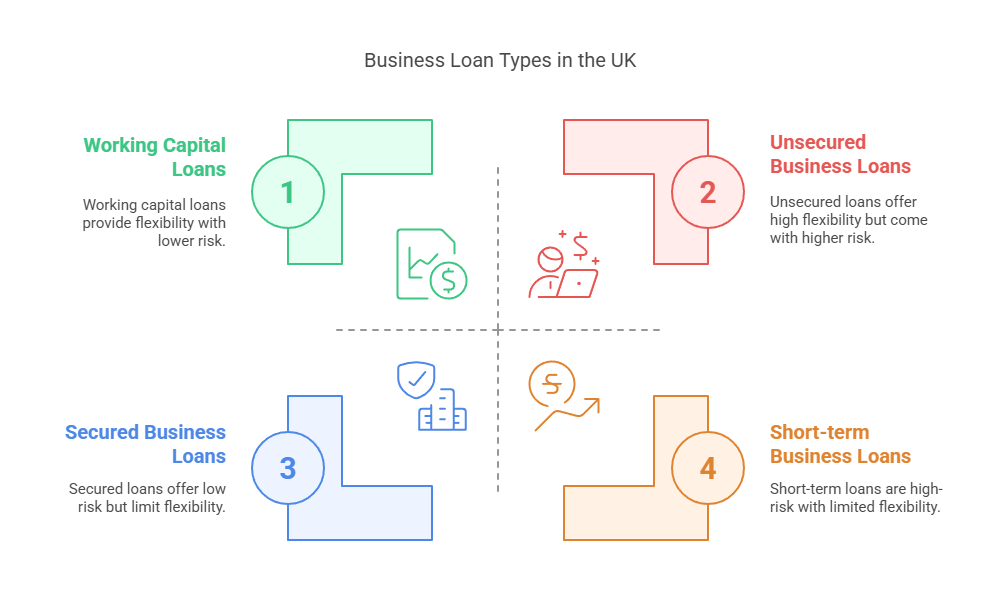
Unsecured Business Loans
Unsecured business loans provide financing without requiring collateral, making them an accessible option for businesses without significant assets or those unwilling to risk their existing assets.
These loans typically range from £5,000 to £100,000, though some lenders may offer higher amounts to established businesses with strong credit profiles. Repayment terms generally span from six months to five years, with interest rates varying based on your business’s creditworthiness, trading history, and the lender’s assessment of risk.
The key advantages of unsecured business loans include:
- Faster application and approval processes
- No risk to specific business assets
- Flexibility in how funds can be used
- Accessibility for businesses with fewer tangible assets
However, these benefits come with certain trade-offs:
- Higher interest rates compared to secured loans (typically 7-30% APR)
- Shorter repayment terms
- Lower maximum loan amounts
- Stricter eligibility criteria regarding credit history and business performance
To qualify for an unsecured business loan in the UK, lenders typically look for:
- At least 6-12 months of trading history
- Minimum annual turnover requirements (often £50,000+)
- Good personal and business credit scores
- Proof of ability to make repayments
Unsecured loans are particularly suitable for businesses needing quick access to funds for opportunities like inventory purchases, marketing campaigns, hiring staff, or managing seasonal cash flow fluctuations.
Have you considered how an unsecured loan might help your business seize new opportunities without putting your assets at risk?
Learn everything you need to know about unsecured and secured loans here
Secured Business Loans
Secured business loans require you to pledge specific assets as collateral, providing the lender with security if you’re unable to repay the loan. This reduced risk for lenders translates into several advantages for borrowers.
Learn everything you need to know about unsecured and secured loans here
In the UK market, secured loans typically offer:
- Lower interest rates (usually 3-12% APR)
- Higher borrowing limits, potentially into millions of pounds
- Longer repayment terms, sometimes extending to 25 years
- More flexible eligibility criteria
- Better terms for businesses with less-than-perfect credit histories
Common assets used as collateral include:
- Commercial property
- Business equipment and machinery
- Vehicles
- Inventory
- Accounts receivable
- Personal assets (in some cases)
The application process for secured loans is more thorough than unsecured options. Lenders will conduct detailed assessments of both your business finances and the value of the collateral being offered. This typically involves property valuations, asset inspections, and comprehensive financial reviews.
While secured loans offer attractive terms, they come with the significant risk of losing your pledged assets if you default on repayments. This makes careful financial planning essential before committing to this type of financing.
Secured business loans are particularly well-suited for:
- Major capital investments
- Commercial property purchases
- Business acquisitions
- Long-term expansion projects
- Debt consolidation
For established businesses with valuable assets, secured loans can provide substantial capital at competitive rates, fueling significant growth opportunities that might otherwise be out of reach.
Short-term Business Loans
Short-term business loans provide quick capital injections designed to address immediate financial needs with repayment typically expected within 3 to 18 months. These loans have become increasingly popular in the UK market due to their accessibility and rapid funding capabilities.
The defining characteristics of short-term business loans include:
- Loan amounts typically ranging from £5,000 to £500,000
- Higher interest rates than long-term options (often 8-25% APR)
- Weekly or daily repayment schedules rather than monthly
- Streamlined application processes with minimal documentation
- Funding often available within 24-48 hours of approval
These loans serve numerous practical business purposes, including:
- Covering unexpected expenses or emergency repairs
- Managing seasonal inventory purchases
- Bridging gaps between customer payments
- Seizing limited-time opportunities like bulk purchase discounts
- Handling tax obligations or regulatory compliance costs
Consider a retail business facing an unexpected opportunity to purchase discounted stock from a supplier going out of business. A short-term loan could provide the immediate capital needed to secure the inventory at below-market rates, creating significant profit potential when the stock is sold.
The expedited nature of short-term loans makes them particularly valuable in time-critical situations. However, this convenience comes with important considerations:
- Higher overall cost of capital due to elevated interest rates
- More frequent repayment schedules that impact cash flow
- Less time to generate returns on the borrowed capital
- Potential for debt cycles if used repeatedly for ongoing issues
To qualify for short-term business loans in the UK, lenders typically look for:
- At least 6-12 months of trading history
- Minimum monthly revenue requirements (often £5,000+)
- Basic creditworthiness (though standards are often more flexible than traditional loans)
- Clear purpose for the funds
How quickly could your business respond to an unexpected opportunity or challenge with the right short-term financing in place?
Get a short term loan quotes with Guavas Finance in 24-48 hours.
Working Capital Loans
Working capital loans are specifically designed to finance the everyday operational needs of your business rather than long-term assets or investments. These loans help bridge the gap between when you need to pay your expenses and when you receive payment from your customers—effectively keeping your business running smoothly through fluctuations in cash flow.
In the UK business financing landscape, working capital loans have become essential tools for businesses across all sectors, particularly those dealing with seasonal variations, project-based work, or extended payment terms from clients. These loans typically range from £5,000 to £500,000, with terms usually spanning 3 months to 3 years.
The primary purpose of working capital financing is to maintain healthy cash flow for:
- Covering payroll and staff expenses
- Paying suppliers and vendors on time
- Managing inventory purchases
- Handling operational costs like rent and utilities
- Marketing and sales initiatives
- Taking advantage of supplier discounts
One of the key benefits of working capital loans is their flexibility. Unlike loans for specific assets or projects, you can generally use these funds wherever they’re needed most in your business operations.
UK lenders offer several variations of working capital financing:
- Term loans: Fixed amount with regular repayments over a set period
- Revolving credit facilities: Similar to credit cards, allowing you to draw and repay funds as needed
- Invoice financing: Using unpaid invoices to secure immediate cash
- Overdraft facilities: Allowing your business bank account to go negative up to an agreed limit
A restaurant owner in Birmingham used a working capital loan to manage cash flow during a three-month renovation of the street outside his establishment. The loan helped cover staff wages and supplier payments during the period of reduced customer traffic, allowing the business to emerge from the disruption without laying off valued employees or damaging supplier relationships.
To qualify for working capital loans, lenders typically assess:
- Your business’s cash flow patterns
- Revenue stability and growth trajectory
- Credit history and existing debt obligations
- Time in business (usually minimum 6-12 months)
- Industry sector and seasonal factors
What aspects of your business operations could benefit from improved working capital management?
Learn how to optimize your working capital cycle
Invoice Financing
Invoice financing transforms your unpaid invoices into immediate working capital, addressing one of the most common challenges UK businesses face: the gap between delivering goods or services and receiving payment.
There are two primary types of invoice financing available in the UK market:
- Invoice Factoring: You sell your invoices to a factoring company, which advances you 70-90% of the invoice value immediately. The factor then collects payment directly from your customers when invoices are due. Once collected, you receive the remaining balance minus the factor’s fee. This option includes credit control services, effectively outsourcing your collections process.
- Invoice Discounting: Similar to factoring but more discreet, as you maintain control of your sales ledger and customer relationships. Your customers are unaware of the financing arrangement, and you continue to collect payments yourself, passing them to the lender once received.
The process typically works as follows:
- You deliver goods or services and issue invoices to customers
- You submit these invoices to your invoice finance provider
- The provider advances 70-90% of the invoice value within 24-48 hours
- Your customers pay according to your agreed terms (typically 30-90 days)
- Once payment is received, you get the remaining balance minus fees
A construction subcontractor in Manchester used invoice financing to transform their business growth trajectory. With clients typically paying 60-90 days after project completion, the company struggled to take on multiple projects simultaneously due to cash flow constraints. By implementing invoice financing, they accessed funds immediately after invoicing, allowing them to purchase materials and pay workers for new projects without waiting for previous clients to pay. This enabled them to triple their project capacity within a year.
The costs associated with invoice financing include:
- Discount or service fee: Usually 1-3% of the invoice value
- Administration fees: Often a small percentage of your turnover
- In some cases, additional charges for credit protection or specific services
For many UK businesses, the benefits of invoice financing outweigh the costs:
- Immediate access to cash tied up in unpaid invoices
- Financing that grows automatically with your sales
- No need for additional collateral beyond the invoices themselves
- Improved cash flow predictability
- Reduced administrative burden (particularly with factoring)
- Often available to businesses that might not qualify for traditional loans
How much working capital could you unlock from your current unpaid invoices?
Learn how to optimise your invoice financing facility here.
Asset Financing
Asset financing provides a strategic pathway for UK businesses to acquire essential equipment, vehicles, machinery, or technology without large upfront capital expenditures. This financing method uses the asset itself as security for the loan, making it an accessible option for businesses across various growth stages.
The UK asset finance market has grown substantially in recent years, with the Finance & Leasing Association reporting over £35 billion in asset finance provided to businesses annually. This growth reflects the increasing recognition of asset finance as a practical solution for equipment acquisition and business development.
There are several key types of asset financing available:
- Hire Purchase: You make regular payments over an agreed term (typically 1-7 years), and ownership transfers to your business once the final payment is made. This option allows you to claim capital allowances and spread the VAT payment.
- Finance Lease: You lease the asset for most of its useful life, making regular payments that cover the full cost plus interest. While you never own the asset, you gain full operational use of it and can often negotiate a peppercorn rental or purchase option at the end of the term.
- Operating Lease: Ideal for assets that quickly become obsolete or are needed for specific projects. You lease the asset for less than its useful economic life, with payments covering only the value the asset loses during the lease period.
- Refinancing/Sale and Leaseback: If you already own valuable assets outright, you can sell them to a finance company and immediately lease them back, releasing the capital tied up in them while continuing to use the assets.
A logistics company in Leeds used asset financing to upgrade their entire fleet of delivery vehicles. Rather than depleting their cash reserves or seeking a large traditional loan, they arranged a finance lease that allowed them to spread the cost over five years. The new, more fuel-efficient vehicles reduced their operating costs immediately, while the fixed monthly payments made budgeting straightforward.
Asset financing offers numerous advantages for UK businesses:
- Preservation of working capital for other business needs
- Fixed, predictable payments that simplify budgeting
- Potential tax benefits (capital allowances and tax-deductible lease payments)
- Easier approval compared to unsecured lending
- Financing that matches the useful life of the asset
- Protection from technology obsolescence (with certain lease structures)
What business assets could you upgrade or acquire to improve efficiency or expand your capabilities?
Discover which assets qualify for asset financing
Credit Lines
Business credit lines offer a flexible financing solution that combines the accessibility of a credit card with the more substantial funding capacity of a traditional loan. Unlike fixed-term loans that provide a lump sum, credit lines establish a maximum borrowing limit from which you can draw funds as needed and repay at your own pace, only paying interest on the amount you use.
In the UK business financing landscape, credit lines have gained significant popularity due to their adaptability to varying business needs. They function as a financial safety net, allowing businesses to:
- Cover unexpected expenses without applying for new financing
- Manage seasonal fluctuations in cash flow
- Take advantage of time-sensitive opportunities
- Bridge temporary gaps between receivables and payables
- Fund smaller projects without committing to full loan amounts
The structure of business credit lines typically includes:
- Credit limits ranging from £1,000 to £500,000+ (with higher amounts available for established businesses)
- Variable interest rates, usually between 7% and 25% APR
- Minimum monthly repayments (often 2-3% of the outstanding balance)
- Annual or monthly facility fees in some cases
- Terms that can be ongoing (revolving) or fixed for a specific period
A specialty food retailer in Edinburgh uses a business credit line to manage the seasonal nature of their business. During summer months when tourism peaks, they draw on the credit line to increase inventory and staffing. As autumn sales generate strong cash flow, they repay the balance, minimizing interest costs while maintaining the flexibility to access funds again when needed.
One of the primary advantages of credit lines is their “use it or don’t pay for it” nature. Unlike term loans where you pay interest on the entire amount from day one, credit lines only charge interest on the portion you’ve drawn down. This makes them particularly cost-effective for businesses with fluctuating capital needs.
How could a flexible credit line help your business navigate seasonal changes or unexpected opportunities?
Merchant Cash Advance
A merchant cash advance (MCA) offers an innovative financing solution particularly suited to retail, hospitality, and service businesses that process significant credit and debit card transactions. Rather than fixed monthly repayments, MCAs take a percentage of your daily card sales, creating a repayment structure that flexes with your business performance.
This financing option has gained substantial traction in the UK market, especially among businesses with fluctuating or seasonal revenue patterns. The key features of merchant cash advances include:
- Advances typically ranging from £5,000 to £500,000
- Repayment through a fixed percentage of daily card sales (usually 8-20%)
- No fixed repayment term – the advance is repaid faster when sales are strong and slower when sales decrease
- Factor rates rather than interest rates, typically ranging from 1.1 to 1.5 times the advance amount
- Minimal paperwork compared to traditional loans
- Approval decisions often based primarily on card sales history rather than credit scores
The application process is straightforward, typically requiring:
- 4-12 months of card processing statements
- Bank statements
- Basic business information
- Proof of trading history
A café owner in Cardiff used a merchant cash advance to fund a kitchen renovation during their slow winter season. With repayments tied to a percentage of card sales, the burden was lightest during the quiet months and increased naturally as spring brought more customers and higher revenue. This alignment between repayments and cash flow allowed the business to complete necessary improvements without creating cash flow pressure.
While merchant cash advances offer significant benefits in terms of flexibility and accessibility, they typically carry a higher overall cost compared to traditional financing. The convenience of percentage-based repayments and rapid funding (often within 24-48 hours of approval) comes at a premium.
MCAs are particularly well-suited for:
- Businesses with high volumes of card transactions
- Seasonal operations needing financing that adapts to revenue fluctuations
- Retailers requiring quick access to capital for inventory purchases
- Businesses with less-than-perfect credit but strong sales performance
- Hospitality venues funding renovations or equipment upgrades
Could your business benefit from financing that automatically adjusts repayments based on your daily sales performance?
Looking for a more in-depth understanding of Merchant Cash Advances for your business – click here.
Government Loans
The UK government offers various loan schemes designed to support businesses at different stages of development and with specific needs. These programs often provide more favorable terms than commercial loans, making them attractive options for eligible businesses.
Some of the key government-backed loan schemes include:
- Start Up Loans: Personal loans of £500 to £25,000 for new businesses trading for less than 24 months, with fixed 6% interest rates and terms up to five years. These loans also come with 12 months of free mentoring support.
- Recovery Loan Scheme: Introduced to help businesses recover from the pandemic, offering up to £2 million with government backing to improve access to finance for viable businesses.
- Regional Growth Funds: Various regional programs providing loans to businesses in specific geographic areas to stimulate local economic growth and job creation.
- Innovation loans: Provided through Innovate UK for businesses developing innovative products, processes, or services, with favorable terms to support R&D activities.
- Export financing: The UK Export Finance department offers various loan guarantees and insurance products to help businesses export goods and services internationally.
A technology startup in Newcastle secured a Start Up Loan to develop their prototype product. Beyond the favorable interest rate, the mentoring support provided crucial guidance on business planning and market entry strategy. Two years later, the company successfully raised venture capital funding, citing the early government support as instrumental in achieving their initial milestones.
The advantages of government-backed loans typically include:
- Lower interest rates than commercial alternatives
- Longer repayment terms
- Reduced or no requirements for personal guarantees
- Additional support services like mentoring or business advice
- More flexible eligibility criteria for businesses that might struggle to secure traditional financing
Application processes vary by program but generally require:
- A solid business plan
- Financial projections
- Evidence of market opportunity
- Demonstration of how the loan will contribute to business growth or recovery
Government loans can be particularly valuable for:
- New businesses with limited trading history
- Companies in underserved geographic regions
- Businesses focused on innovation or exports
- Enterprises with social or environmental missions
- Companies recovering from economic challenges
Could your business qualify for government support that offers better terms than commercial financing?
Which is Best for Your Business?
Selecting the right financing solution for your business requires careful consideration of your specific circumstances, needs, and goals. There’s no one-size-fits-all answer, but asking yourself the following questions can guide your decision-making process:
What exactly do you need the funding for?
- Short-term operational costs might be best served by working capital loans or credit lines
- Equipment or asset purchases align well with asset financing options
- Property acquisition typically requires secured long-term loans
- Bridging cash flow gaps from unpaid invoices points toward invoice financing
How quickly do you need the funds?
- Need money within 24-48 hours? Consider merchant cash advances or short-term loans
- Can wait 1-2 weeks? Invoice financing or unsecured loans might work
- Planning ahead with 3-4 weeks to spare? Secured loans or asset financing become viable options
- Long-term planning with months available? Government loans could offer the best terms
What assets does your business have?
- Significant property or equipment? Secured loans might offer the best rates
- Limited tangible assets? Unsecured loans or revenue-based financing could be appropriate
- Substantial unpaid invoices? Invoice financing can unlock that value
- Strong card sales history? Merchant cash advances become an option
What’s your business’s financial profile?
- Strong credit history and established trading? Traditional bank loans might offer optimal terms
- Limited trading history but strong growth? Alternative lenders may be more receptive
- Seasonal or fluctuating revenue? Consider options with flexible repayment structures
- Less-than-perfect credit? Secured loans or asset-based lending could still be accessible
A garden center in Somerset faced this decision when looking to expand their operations. After considering various options, they chose a combination approach: asset financing for new greenhouse equipment and a seasonal credit line to manage inventory purchases ahead of their peak spring and summer seasons. This tailored strategy provided the fixed assets needed for growth while offering flexible working capital that aligned with their seasonal business cycle.
Remember that the best financing solution might involve combining different loan types to address various aspects of your business needs. Many successful businesses maintain relationships with multiple lenders, each serving a specific purpose in their overall financial strategy.
What specific business goals are you looking to achieve with additional financing?
Why not get quotes from Guavas Finance today.
Alternative Financing Solutions to Consider
Beyond traditional loans, the UK financial landscape offers innovative alternative financing solutions that might better suit your business’s unique needs. These options have grown significantly in popularity, particularly among startups and growth-stage businesses seeking more flexible funding arrangements.
Peer-to-Peer (P2P) Business Lending
P2P platforms connect businesses directly with individual and institutional investors willing to lend money. This model often results in competitive interest rates and more flexible terms than traditional banking. UK platforms like Funding Circle, RateSetter, and ThinCats have facilitated billions in business loans, with application processes that are typically faster and more streamlined than traditional banks.
Equity Crowdfunding
For businesses willing to share ownership in exchange for capital, equity crowdfunding platforms like Seedrs and Crowdcube allow you to raise funds from multiple investors who receive shares in your company. This option works particularly well for businesses with strong growth potential and compelling stories that can engage potential investors.
Revenue-Based Financing
This innovative model provides capital in exchange for a percentage of future revenue until a predetermined amount is repaid. Unlike traditional loans with fixed monthly payments, repayments flex with your business performance—higher when revenue is strong and lower during slower periods. This alignment with cash flow makes it particularly suitable for businesses with recurring revenue models.
A software company in Bristol used revenue-based financing to fund their marketing expansion. Rather than taking on fixed debt payments before seeing results, they secured funding that scaled repayments with their growing monthly subscription revenue. This approach reduced risk while providing the capital needed to accelerate growth.
Supply Chain Finance
This solution helps businesses optimize working capital by allowing suppliers to receive early payment on invoices while buyers extend their payment terms. Specialized platforms facilitate these arrangements, benefiting both parties—suppliers improve cash flow while buyers preserve working capital.
Venture Debt
For high-growth businesses that have already raised equity funding, venture debt provides additional capital without the dilution of further equity rounds. These loans typically come with warrants (options to purchase equity) and are designed specifically for venture-backed companies with strong growth trajectories but negative cash flow.
Grant Funding
The UK offers numerous grant programs for businesses, particularly those involved in innovation, research and development, or specific priority sectors. Unlike loans, grants don’t require repayment, making them an extremely attractive funding source when available. Organizations like Innovate UK, the National Lottery Heritage Fund, and various regional development agencies provide grant opportunities worth exploring.
When considering alternative financing, evaluate:
- The true cost of capital (beyond just interest rates)
- Impact on your business’s ownership and control
- Alignment with your growth trajectory and cash flow patterns
- Potential for additional value beyond just funding (like mentorship or connections)
- Reporting requirements and operational implications
Could an alternative financing solution provide not just capital but strategic advantages for your business growth?
Looking for a Business Loan?
When you’re ready to pursue business financing, taking a strategic approach can significantly improve your chances of securing the right funding on favorable terms. Here’s a practical roadmap to guide you through the process:
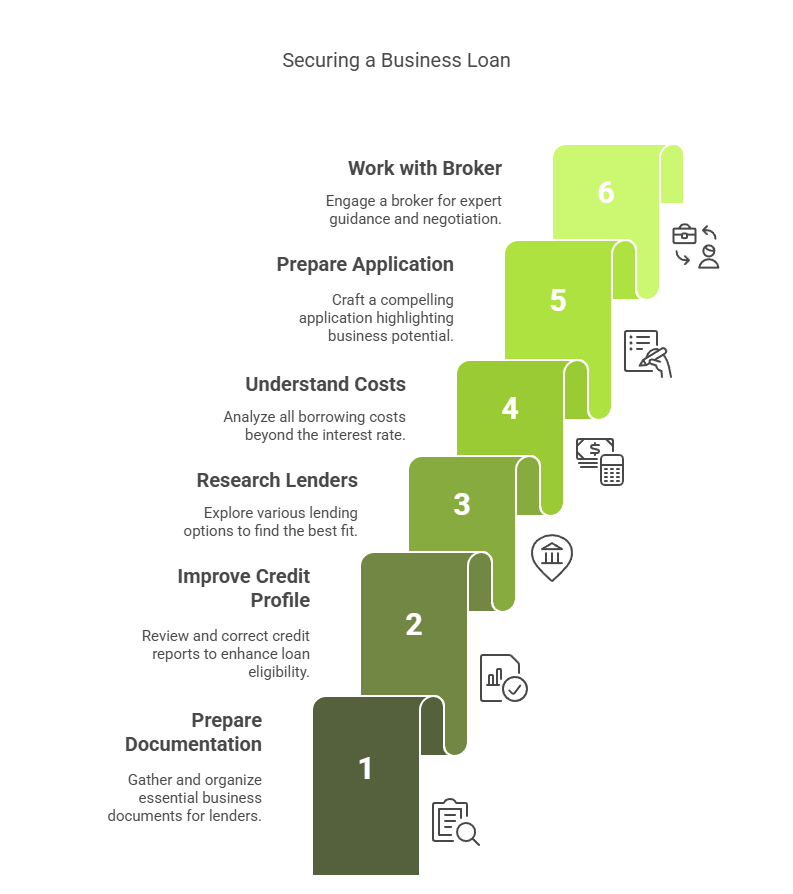
- Prepare Your Business Documentation
Lenders will require various documents to assess your application. Having these prepared in advance can streamline the process:
- Business plan with clear growth strategy
- Up-to-date financial statements (balance sheet, profit & loss, cash flow)
- Bank statements (typically the last 3-6 months)
- Tax returns (business and sometimes personal)
- Details of existing debt obligations
- Proof of trading history and business registration
- Asset information (for secured loans)
- Sales forecasts and financial projections
- Check and Improve Your Credit Profile
Before applying, review both your business and personal credit reports. Lenders will examine these closely, so addressing any issues beforehand is crucial:
- Request your credit reports from major agencies (Experian, Equifax, Creditsafe)
- Correct any errors or outdated information
- Reduce outstanding debt where possible
- Ensure all business filings and tax obligations are current
- Consider building credit history with smaller facilities before applying for larger loans
- Research and Compare Lenders
The UK lending market offers diverse options, each with different specialties and criteria:
- Traditional banks (typically best rates but stricter requirements)
- Challenger banks (often more flexible with faster processes)
- Alternative lenders (specialized in specific loan types or industries)
- Online platforms (streamlined application processes)
- Government-backed schemes (potentially more favorable terms)
- Understand the Full Cost of Borrowing
Look beyond the headline interest rate to understand the total cost:
- APR (Annual Percentage Rate)
- Arrangement or origination fees
- Early repayment charges
- Security or guarantee requirements
- Administration costs
- Late payment penalties
- Prepare a Strong Application
Your application should clearly demonstrate:
- Why you need the funding (specific purpose)
- How it will benefit your business (expected ROI)
- Your ability to repay (cash flow projections)
- Your business’s track record and growth potential
- Risk mitigation strategies
A marketing agency in Glasgow significantly improved their loan application success by creating a detailed presentation showing exactly how the requested funding would generate new business through specific marketing channels, complete with conversion projections and case studies from previous campaigns. This level of detail gave lenders confidence in both the purpose of the loan and the likelihood of repayment.
- Consider Working with a Broker or Advisor
Business loan brokers can help navigate the complex lending landscape, potentially accessing options you might not find independently. They can:
- Match your needs with appropriate lenders
- Help prepare stronger applications
- Negotiate terms on your behalf
- Save time in researching options
- Provide insights on approval likelihood
Remember that securing business financing is not just about getting approved—it’s about finding the right solution that supports your business goals while maintaining financial stability. Taking time to prepare thoroughly and explore multiple options will lead to better outcomes for your business’s long-term success.
Are you ready to take the next step in securing financing for your business growth?
Get business loan quotes from Guavas Finance today!
Ultimately, selecting the right alternative financing option will give your business the necessary capital to thrive, seize opportunities, and achieve its long-term objectives. Choose a financing option that offers room for future growth and aligns with your long-term business objectives. Weigh the pros and cons of each financing option, considering factors such as funding requirements, repayment terms, costs, and your business’s growth plans. If necessary, seek guidance from financial advisors or experts who can provide valuable insights based on your specific business circumstances.
Exploring alternative financing options provides business owners a broader range of funding possibilities beyond traditional loans. We have examined various options, including lines of credit, equipment financing, working capital loans, government-backed loans, and peer-to-peer lending. We have also compared these options to traditional loans, highlighting their differences in terms of flexibility, collateral, credit requirements, repayment structures, and costs. By understanding these options and their pros and cons, businesses can make well-informed decisions that optimise their financial strategy and support their growth objectives.