
Running a small business often means navigating unpredictable cash flow challenges. When opportunity knocks—or when unexpected expenses arise—traditional bank loans might not be accessible or quick enough to meet your needs. This is where merchant cash advances (MCAs) have become a popular alternative for UK businesses.
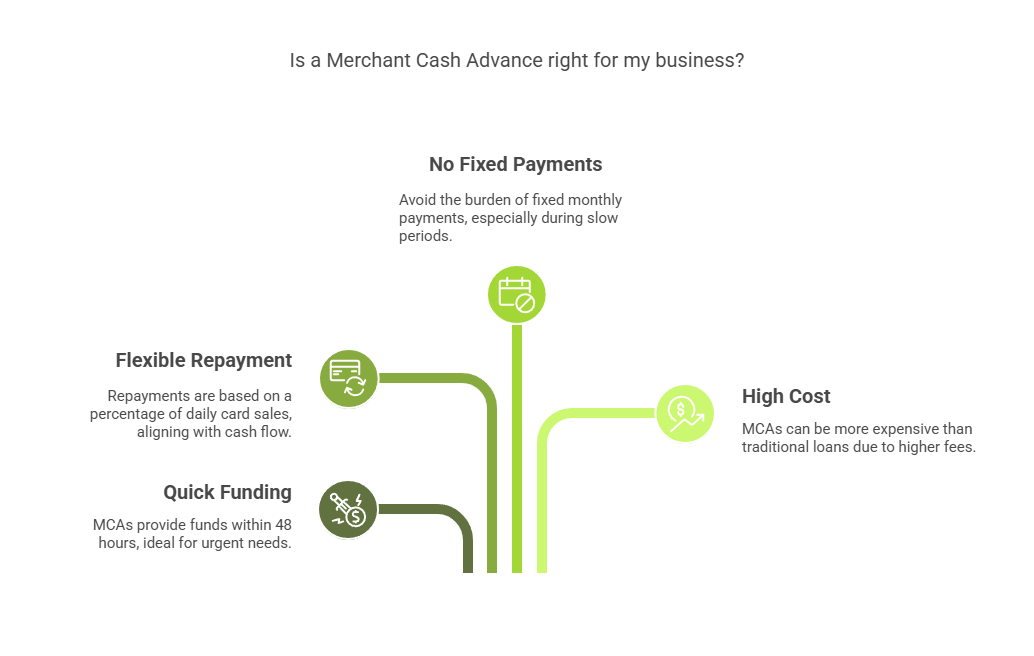
Imagine you own a thriving restaurant in Manchester. Your business is doing well, but your kitchen equipment desperately needs upgrading before the busy holiday season. You need £15,000 quickly, but your bank requires extensive paperwork and weeks of waiting. With an MCA, you could receive funds within 48 hours, and instead of fixed monthly payments, you’d repay through a small percentage of your daily card sales—10% when business is booming during the holidays, that same 10% when things slow down in January. This flexibility aligns perfectly with your business’s natural cash flow patterns.
MCAs have transformed how thousands of UK businesses access capital, with providers advancing millions of pounds each year. But is this funding solution right for your business? Let’s explore how merchant cash advances work, their advantages and limitations, and how to determine if they’re the right fit for your specific needs.
What is a merchant cash advance?
A merchant cash advance is a type of business funding specifically designed for businesses that process credit and debit card payments. Unlike traditional loans, an MCA provides you with an upfront lump sum in exchange for a percentage of your future card sales plus a fixed fee.
The fundamental distinction between MCAs and conventional loans lies in their structure. With an MCA, you’re essentially selling a portion of your future card sales at a discount. This means:
- There’s no fixed repayment term
- Payments fluctuate with your business performance
- Repayments happen automatically through your card processing
- The advance is typically unsecured, requiring no collateral
This unique structure makes MCAs particularly valuable for businesses with seasonal or fluctuating revenue patterns. When sales are strong, you pay back more; when sales dip, your repayments automatically decrease, reducing financial pressure during slower periods.
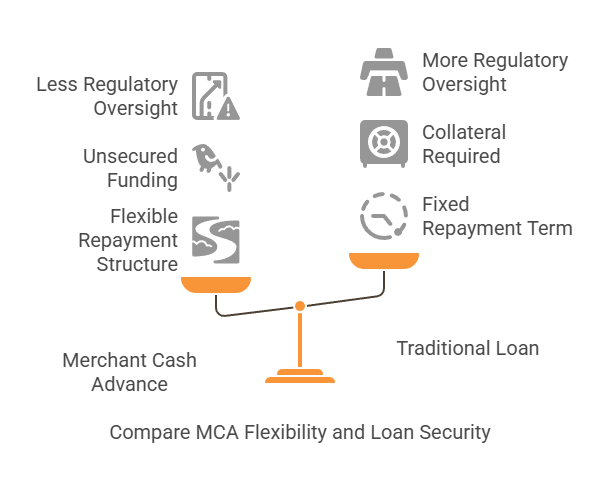
MCAs are technically not loans but rather an advance against future revenue. This distinction matters because it means they operate outside traditional lending regulations, allowing providers to offer funding to businesses that might not qualify for conventional bank loans due to limited trading history or less-than-perfect credit scores.
The advance amount typically ranges from 80% to 150% of your average monthly card sales, depending on your sales history, business stability, and the provider’s risk assessment.
Learn more about different types of business funding options
How does a merchant cash advance work?
The merchant cash advance process follows a straightforward path from application to repayment. Here’s a detailed breakdown of how it works:
- Application and assessment: You submit an application along with several months of card processing statements and bank statements. The provider analyzes your sales history to determine eligibility and advance amount.
- Advance offer: If approved, you’ll receive an offer specifying:
- The advance amount (the lump sum you’ll receive)
- The factor rate (typically between 1.1 and 1.5)
- The total repayment amount (advance amount multiplied by the factor rate)
- For example, with a factor rate of 1.2 and an advance of £10,000, you would repay £12,000 in total.
- Holdback percentage agreement: You and the provider agree on a “holdback” percentage—typically between 5% and 20% of your daily card sales—that will automatically go toward repaying the advance.
- Funding: Once agreements are signed, funds are typically deposited into your business account within 24-48 hours.
- Automatic repayments: The agreed percentage of your daily card sales is automatically deducted and applied to your outstanding balance. This continues until the full amount (advance plus fee) is repaid.
The beauty of this structure is that repayments automatically adjust to your business performance. On a day when you process £1,000 in card sales with a 10% holdback rate, you’ll repay £100. On a slower day with only £500 in sales, you’ll repay just £50.
There’s typically no fixed repayment term with an MCA. The time it takes to repay depends entirely on your sales volume—businesses with higher card sales will repay faster than those with lower volumes. Most advances are typically repaid within 4 to 12 months, though this varies significantly based on business performance.
It’s worth noting that while the factor rate might seem low compared to annual interest rates, the effective annual percentage rate (APR) can be much higher due to the shorter repayment period. This is one reason why MCAs are generally better suited for short-term funding needs rather than long-term investments.
How can a merchant cash advance help your business?
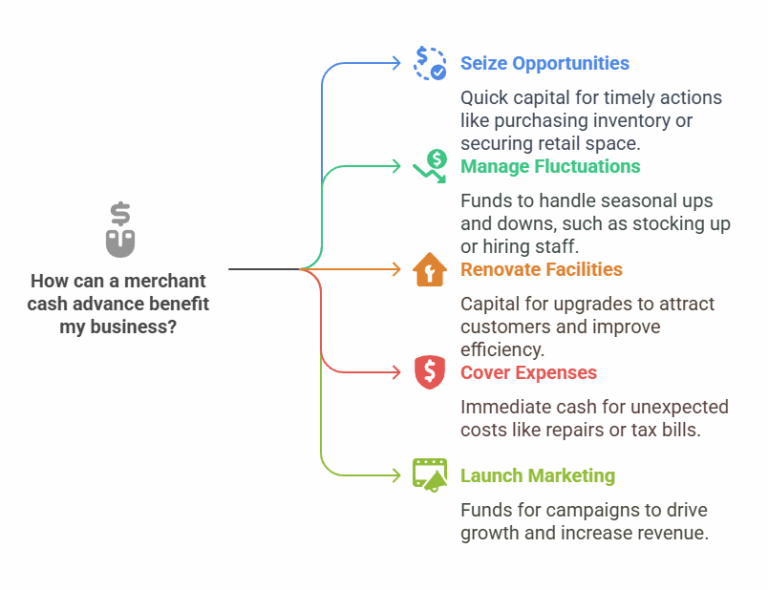
Merchant cash advances can be a powerful tool for business growth and stability when used strategically. Here are specific ways an MCA can benefit your business:
Seizing time-sensitive opportunities: When a chance to grow your business emerges, timing is often critical. An MCA provides quick access to capital that can help you act decisively on opportunities like:
- Purchasing discounted inventory in bulk
- Taking advantage of limited-time marketing opportunities
- Securing prime retail space before competitors
- Acquiring equipment at auction or clearance prices
Managing seasonal fluctuations: Many businesses experience predictable busy and slow seasons. A merchant cash advance can help you:
- Stock up on inventory before peak seasons
- Hire and train temporary staff ahead of busy periods
- Fund marketing campaigns to maximize seasonal revenue
- Cover operating expenses during predictable slow periods
Renovating or upgrading facilities: Physical improvements to your business premises can attract more customers and improve operational efficiency. An MCA can fund:
- Store renovations and rebranding
- Kitchen or production equipment upgrades
- Technology investments like POS systems or inventory management software
- Energy-efficient upgrades that reduce long-term costs
Covering unexpected expenses: Business emergencies happen—equipment breaks down, facilities need urgent repairs, or unexpected tax bills arrive. An MCA can provide the quick cash injection needed to address:
- Emergency equipment repairs or replacement
- Unexpected property maintenance issues
- Unplanned tax obligations or compliance costs
- Temporary cash flow shortfalls
Launching marketing initiatives: Effective marketing can drive significant business growth, but often requires upfront capital. An MCA can fund:
- Digital marketing campaigns
- Website development or upgrades
- Local advertising initiatives
- Special promotions or events
The flexibility of merchant cash advances makes them particularly valuable for businesses with variable income streams. A seasonal business like a beachside ice cream shop might use an MCA to fund pre-summer renovations, then repay more quickly during peak months when sales are highest.
Have you considered how an injection of capital could help you overcome current business challenges or capitalize on opportunities? The right funding at the right time can make all the difference in your business’s trajectory.
How much can you borrow through a merchant cash advance?
The amount you can borrow through a merchant cash advance depends primarily on your business’s card sales volume. Most UK providers offer advances ranging from £5,000 to £300,000, though some may go higher for established businesses with substantial card revenue.
Typically, providers will advance anywhere from 80% to 150% of your average monthly card sales. For example:
- A business processing £10,000 monthly in card sales might qualify for advances between £8,000 and £15,000
- A business processing £50,000 monthly could potentially access between £40,000 and £75,000
- Larger operations with £100,000+ monthly card sales might qualify for advances of £80,000 to £150,000 or more
Several factors influence the specific amount you’ll be offered:
Sales volume and consistency: Providers analyze your card sales history, looking for stable or growing revenue patterns. Consistent sales typically qualify for higher advances than highly variable ones.
Time in business: Established businesses with longer trading histories generally qualify for larger advances than newer ventures. Most providers prefer businesses with at least 6-12 months of trading history.
Industry type: Some industries are considered higher risk than others. Businesses in stable sectors may receive more favorable terms than those in volatile or seasonal industries.
Overall business health: Providers will examine your bank statements and other financial information to assess your business’s overall financial stability, including:
- Average daily bank balance
- Frequency of overdrafts or returned payments
- Consistency of revenue deposits
- Expense management
Existing financial obligations: If you already have other advances or significant debt obligations, this may limit the amount you can borrow. Providers want to ensure you’re not overextending your business financially.
When considering how much to request, carefully calculate your funding needs and how the repayment structure will impact your daily cash flow. Remember that while repayments adjust with your sales, the holdback percentage remains constant—so ensure your business can comfortably operate with that percentage being deducted from daily card revenue.
Some providers offer the option to “top up” your advance once you’ve repaid a certain percentage (often 50-70%) of your original amount. This can be useful if you find you need additional funds before fully repaying the initial advance.
Who can apply for a merchant cash advance?
Merchant cash advances are designed to be more accessible than traditional bank loans, but they still have specific eligibility criteria. Here’s who can typically apply:
Businesses that accept card payments: Since MCAs are repaid through future card sales, they’re primarily available to businesses that regularly process credit and debit card transactions. This includes:
- Retail shops
- Restaurants, cafés, and bars
- Hotels and accommodation providers
- Salons and spas
- Healthcare practices
- E-commerce businesses
Established businesses: Most providers require at least 3-6 months of trading history, though some may consider businesses with as little as 3 months of card processing statements.
Minimum monthly card sales: Providers typically look for businesses processing at least £3,500-£5,000 in monthly card sales, though requirements vary between lenders.
UK-based businesses: To qualify for a UK merchant cash advance, your business must be registered and operating in the United Kingdom with a UK business bank account.
Business structure: MCAs are available to various business structures, including:
- Limited companies
- Partnerships
- Sole traders (though some providers may have additional requirements)
- LLPs (Limited Liability Partnerships)
Notably, merchant cash advances often have more flexible eligibility criteria than traditional bank loans. Many providers will consider businesses with:
- Less-than-perfect credit histories
- Limited trading history
- Few physical assets
- Previous loan rejections
This accessibility makes MCAs particularly valuable for small and medium-sized businesses that might struggle to secure conventional financing. However, providers will still assess risk factors including your business stability, sales trends, and overall financial health.
It’s worth noting that businesses with very low card sales percentages (those that deal primarily in cash) may find MCAs less suitable, as the repayment mechanism relies on card transactions.
Check your MCA eligibility with a business loan quote from Guavas Finance
How to Apply for a merchant cash advance?
Applying for a merchant cash advance is typically faster and more straightforward than applying for a traditional bank loan. Here’s a step-by-step guide to navigating the application process:
- Gather your documentation
Before starting your application, collect the following documents:
- 3-6 months of credit card processing statements
- 3-6 months of business bank statements
- Business identification documents (company registration, VAT registration if applicable)
- Proof of trading address
- ID for business owners/directors
Having these ready will streamline the application process significantly.
- Research providers and compare offers
Not all MCA providers offer the same terms. Shop around to find the best:
- Factor rates (the multiplier that determines your total repayment amount)
- Holdback percentages (the percentage of daily sales that will go toward repayment)
- Additional fees or charges
- Customer service reputation
- Industry expertise
Consider working with a broker who can help you compare multiple offers, though be aware they may charge fees for this service.
- Complete the application
Most providers offer online applications that can be completed in 10-15 minutes. You’ll typically need to provide:
- Basic business information (name, address, structure, time in business)
- Owner/director details
- Average monthly card sales
- Requested advance amount
- Purpose of the funding
- Submit documentation and undergo assessment
After the initial application, you’ll submit your supporting documents. The provider will review:
- Your sales history and patterns
- Business stability
- Bank account activity
- Any existing financial obligations
This assessment is typically much faster than traditional loan underwriting, often completed within hours rather than weeks.
- Review and accept your offer
If approved, you’ll receive an offer detailing:
- Advance amount
- Total repayment amount
- Factor rate
- Holdback percentage
- Estimated repayment timeline (though this will vary based on your actual sales)
- Any additional fees
Review these terms carefully, ensuring you understand the total cost and how repayments will impact your daily cash flow.
- Complete the agreement and receive funding
Once you accept the offer, you’ll sign a merchant agreement that outlines all terms and conditions. After signing, funds are typically deposited into your business bank account within 24-48 hours.
The entire application process—from initial inquiry to funding—can often be completed within 2-3 business days, making MCAs one of the fastest funding options available to UK businesses.
Start your MCA application today with Business Loan quotes from Guavas Finance.
Merchant cash advance pros and cons
Like any financial product, merchant cash advances have distinct advantages and disadvantages. Understanding both sides will help you determine if an MCA is the right solution for your business needs.
Benefits
Flexible repayment structure: Perhaps the most significant advantage of MCAs is that repayments automatically adjust to your sales volume. On days when business is slow, you pay less; when sales are strong, you pay more. This alignment with your cash flow can reduce financial stress during slower periods.
Quick access to funds: When business opportunities or emergencies arise, timing is crucial. MCAs typically provide funding within 24-48 hours after approval, compared to weeks or months for traditional bank loans.
Simple application process: The application process is streamlined, requiring minimal documentation and offering quick decisions. This efficiency is particularly valuable for time-pressed business owners.
No fixed repayment term: Unlike loans with set monthly payments over a defined period, MCAs are repaid as you make sales. There’s no deadline pressure—the advance is simply repaid as your business generates revenue.
Accessible to businesses with imperfect credit: MCAs focus more on your recent sales performance than your credit history. This makes them accessible to businesses that might not qualify for traditional bank financing due to past credit issues.
No collateral required: Most MCAs are unsecured, meaning you don’t need to pledge business or personal assets as security. This reduces risk for business owners who may not have substantial assets or prefer not to put them on the line.
Use funds for any business purpose: Unlike some loans that restrict how funds can be used, MCA proceeds can typically be used for any legitimate business purpose—from marketing campaigns to equipment purchases, inventory restocking to emergency repairs.
Cons
Higher cost compared to traditional loans: The convenience and flexibility of MCAs come at a price. The factor rates (typically 1.1 to 1.5) can translate to much higher costs than traditional bank loans, especially if repaid quickly.
Impact on daily cash flow: While the percentage-based repayment adjusts with your sales, having a consistent portion of your daily revenue automatically deducted can impact operational cash flow, particularly for businesses with tight margins.
No benefit from early repayment: Unlike interest-based loans where early repayment reduces interest costs, the fee for an MCA is fixed regardless of how quickly you repay. If your sales increase dramatically after taking an advance, you’ll repay faster but won’t save on costs.
Potential for debt cycles: The quick access to funds can sometimes lead businesses to take additional advances before fully repaying existing ones, potentially creating a cycle of dependency on increasingly expensive funding.
Less regulatory oversight: MCAs aren’t subject to the same regulations as traditional loans, which means fewer consumer protections and potentially less transparent terms.
Variable repayment timeline: While the flexible repayment structure is generally an advantage, it also means you can’t predict exactly when the advance will be fully repaid. This can complicate financial planning for some businesses.
Daily deductions can be challenging: Having repayments deducted daily (rather than monthly) requires careful cash flow management to ensure sufficient funds are available for other business expenses.
Use Credit Score Insights to understand your business credit score
Understanding your business credit score is crucial when considering any type of financing, including merchant cash advances. While MCAs are more accessible to businesses with less-than-perfect credit, a stronger credit profile can still help you secure better terms.
Business credit scores are calculated differently from personal credit scores and take into account factors such as:
- Payment history with suppliers and lenders
- Credit utilization
- Length of credit history
- Public records (CCJs, bankruptcies)
- Company size and age
Tools like Credit Score Insights can help you:
- Monitor your current business credit score
- Identify factors negatively affecting your score
- Receive actionable recommendations for improvement
- Track progress over time
- Compare your score to industry averages
By understanding and improving your business credit profile, you can potentially qualify for more favorable MCA terms or eventually access lower-cost traditional financing options.
Learn more about improving your business credit score.
Is a merchant cash advance the same as a business cash advance?
Yes, the terms “merchant cash advance” and “business cash advance” are often used interchangeably in the UK market. Both refer to the same financial product—an advance against future card sales with repayment through a percentage of daily transactions.
Some providers may use “business cash advance” to emphasize that the product is available to various types of businesses, not just traditional retail merchants. However, the fundamental structure, benefits, and considerations remain the same regardless of terminology.
Can Sole Traders apply for a merchant cash advance?
Yes, sole traders can apply for merchant cash advances, provided they meet the provider’s eligibility criteria regarding card sales volume and time in business. As a sole trader, you’ll typically need to provide:
- Proof of identity
- Proof of address
- Business bank statements
- Card processing statements
- Evidence of trading history
Some providers may have additional requirements for sole traders compared to limited companies, such as higher minimum monthly card sales or longer trading history. However, many UK MCA providers actively work with sole traders across various industries.
What’s the difference between a merchant cash advance and a business loan?
Merchant cash advances and business loans differ in several key ways:
Repayment structure:
- MCA: Percentage of daily card sales, fluctuating with business performance
- Loan: Fixed monthly payments regardless of business performance
Qualification criteria:
- MCA: Primarily based on card sales volume and business stability
- Loan: Typically based on credit history, collateral, and financial statements
Speed of funding:
- MCA: Often within 24-48 hours after approval
- Loan: Can take weeks or months, especially for bank loans
Cost structure:
- MCA: Fixed fee (factor rate) rather than interest rate
- Loan: Interest rate applied to outstanding balance
Security requirements:
- MCA: Typically unsecured, no collateral required
- Loan: Often requires collateral, especially for larger amounts
Regulatory framework:
- MCA: Less regulated as technically not a loan
- Loan: Subject to consumer credit regulations and interest rate caps
The right choice depends on your specific business needs, time constraints, and financial situation.
How much can I borrow?
The amount you can borrow through a merchant cash advance typically ranges from £5,000 to £300,000, though some providers may offer larger advances for established businesses with substantial card sales.
Most providers base their maximum advance amount on your average monthly card sales, typically offering between 80% and 150% of this figure. For example, if your business processes £20,000 in monthly card sales, you might qualify for advances between £16,000 and £30,000.
The specific amount you’ll be offered depends on factors including:
- Your sales volume and consistency
- Length of time in business
- Industry type
- Overall business health
- Existing financial obligations
I’ve got an online store. Will I pay back through online card sales?
Yes, if you operate an e-commerce business or online store, the merchant cash advance repayment will work through your online card sales. The process works similarly to brick-and-mortar businesses:
- You’ll connect your payment processor or gateway to the MCA provider’s system
- The agreed percentage will be automatically deducted from each online transaction
- These deductions continue until the advance is fully repaid
This makes MCAs suitable for online retailers, subscription businesses, and other e-commerce operations with consistent card sales. In fact, the predictable nature of online transactions can sometimes make e-commerce businesses particularly attractive to MCA providers.
Can I repay early?
Most merchant cash advance providers allow early repayment, but it’s important to understand that this typically doesn’t reduce the total cost. Since MCAs use a fixed fee structure rather than accruing interest, the total repayment amount remains the same regardless of how quickly you repay.
For example, if you receive a £10,000 advance with a factor rate of 1.3, your total repayment amount is £13,000 whether it takes 4 months or 12 months to repay through card sales.
Some providers may offer a small discount for early repayment in a lump sum, but this varies by company and should be clarified before signing your agreement. If early repayment is important to you, specifically ask about this option during the application process.
Can I get a merchant cash advance with bad credit?
Yes, merchant cash advances are often accessible to businesses with less-than-perfect credit histories. Unlike traditional loans that heavily weight credit scores in their decision-making, MCA providers focus primarily on your recent card sales volume and business performance.
This makes MCAs a viable option for:
- Businesses with past credit issues
- Newer businesses with limited credit history
- Companies recovering from financial setbacks
- Entrepreneurs with personal credit challenges
While a poor credit history may not disqualify you, it could influence the terms you’re offered. Businesses with stronger credit profiles might receive more favorable factor rates or higher advance amounts.
Some providers may still perform a credit check as part of their assessment, but this is typically just one factor among many in their decision-making process.
Tip to take into consideration when getting a merchant cash advance
When considering a merchant cash advance, keep these essential tips in mind to ensure you make the most of this funding option:
Calculate the true cost: Don’t just look at the factor rate—calculate what the effective annual percentage rate (APR) would be based on your estimated repayment timeline. This helps you compare the MCA with other financing options.
Project your cash flow: Before accepting an advance, run projections to ensure your business can comfortably handle the daily deductions. Consider how seasonal fluctuations might affect your ability to operate with the holdback percentage in place.
Use funds strategically: Prioritize using MCA funds for revenue-generating activities that will help offset the cost of the advance. Investments in marketing, inventory, or equipment that directly increase sales are often ideal uses.
Read the fine print: Carefully review all terms and conditions, paying special attention to:
- Any additional fees beyond the factor rate
- Conditions that might trigger default
- Personal guarantee requirements
- Renewal or top-up conditions
Avoid stacking advances: Taking multiple MCAs simultaneously can create an unsustainable financial burden. If you need additional funding before repaying an existing advance, discuss refinancing options with your current provider.
Keep accurate records: Maintain detailed records of all repayments and regularly reconcile these against your statements to ensure accuracy.
Have an exit strategy: View MCAs as a stepping stone rather than a permanent funding solution. Work toward building your business credit and financial stability to eventually qualify for lower-cost financing options.
Arrange a Merchant Cash Advance Facility through Guavas Finance
Arrange Your Advance Through Guavas Finance
Ready to explore how a merchant cash advance could help your business grow? Guavas Finance is a credit broker: we compare rates and terms across a panel of funders and handle the application for you, so UK small businesses see the whole market rather than one offer.
Our team understands the unique challenges facing businesses across various sectors, from retail and hospitality to professional services and e-commerce. We pride ourselves on providing personalized service and tailored funding solutions that align with your business goals.
With Guavas Finance, you can:
- Apply online in minutes
- Receive a decision from funders on our panel within hours
- Access funds as quickly as 48 hours after approval
- See the full cost of every offer set out up front
- Work with dedicated account managers who understand your industry
Don’t let funding limitations hold your business back. Whether you’re looking to expand, renovate, purchase inventory, or manage seasonal cash flow, get a quote and Guavas Finance can arrange the capital you need, when you need it.
We’ve explored the world of merchant cash advances (MCAs), shedding light on their benefits, drawbacks, qualification criteria, application process, and responsible management strategies. We began by defining MCAs and understanding how they operate, focusing on their unique repayment structure based on sales volume. We then explored the advantages of MCAs, including quick access to funds, flexibility in repayment, and absence of collateral requirements. However, we also highlighted the potential disadvantages, such as the higher cost of financing and the impact on cash flow.
To provide practical guidance, we discussed qualifying and applying for MCAs in the UK, outlining the qualification criteria and necessary documentation. We emphasised the importance of thoroughly reviewing the terms and conditions offered by MCA providers before accepting funding. Moreover, we highlighted the significance of responsible management when dealing with MCAs. We discussed critical practices to ensure successful MCA management: developing a comprehensive budget, tracking and monitoring cash flow, optimising sales and revenue generation, and maintaining financial stability.